Fixtures & Vanities
Freestanding vs Built-In Tub: Pros, Cons, and Cost
Comparing freestanding vs built in tub options? This guide covers installation cost, space needs, cleaning, and which tub type suits your bathroom best.
The freestanding vs built-in tub decision touches everything from your bathroom's floor plan to your plumbing rough-in. The short answer: if you have a standard 5-foot alcove, a built-in almost always makes better use of the space. If you're planning a renovation with an open floor area, a freestanding tub becomes a real option. The full picture involves cost, cleaning habits, soaking depth, and how much plumbing work you're willing to take on.
At a Glance
- A standard 60-inch alcove almost always favors a built-in tub; a freestanding tub needs a room around 8 by 8 feet to breathe.
- Built-in tubs cost less overall ($900 to $3,800 installed) and can double as a tub-shower combo; freestanding tubs cannot.
- Freestanding tubs hold more water (55 to 90 gallons versus 40 to 50) and typically offer 4 to 6 inches more soaking depth.
- Moving a drain from a wall to the floor for a freestanding tub is the single biggest cost driver, often $800 to $1,500 on its own.
- Cast iron and stone resin tubs can add 400 to 600 lbs. to a floor when filled; older homes may need a subfloor check first.
- Lower-entry alcove tubs (14 to 16 inches) are generally easier and safer to step into than freestanding models (20 to 25 inches).
What "Built-In" Actually Means
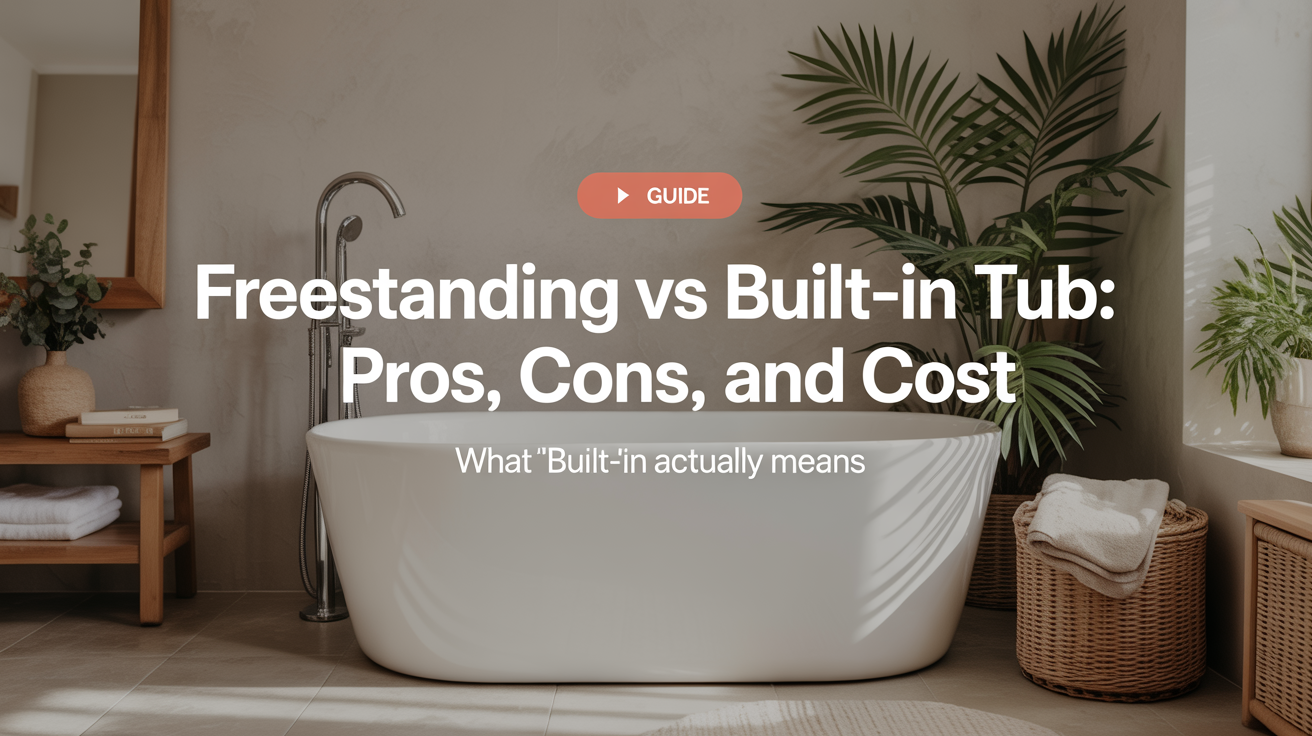
"Built-in" covers three distinct tub styles that share one trait: they're designed to sit against walls.
Alcove Tubs
An alcove tub fits into a three-wall surround, typically 60 inches long by 30 or 32 inches wide. It's what most contractors install by default. One long side faces into the room; the other three sides are finished with tile or a tub surround panel. Because the plumbing goes into the wall at one end, the rough-in is straightforward. These tubs are also compatible with a standard shower valve and curtain rod, so a single installation doubles as a tub-shower combo.
Typical cost for the tub alone: $300 to $900 for a standard acrylic model, $600 to $1,800 or more for cast iron.
Drop-In and Undermount Tubs
A drop-in tub drops into a platform or deck structure, with a rim that rests on top. An undermount hangs below the deck edge, similar to an undermount sink. Both require a builder-constructed surround, usually framed, cement-boarded, and tiled. This adds $500 to $1,500 in carpentry and tile work on top of the tub cost. These styles make sense when a deep soaking experience is the priority and there's no need for an overhead shower.
What Installation Actually Costs
Installing a built-in tub runs $600 to $2,000 in labor, not counting the fixture itself. If you're replacing an existing alcove unit and the plumbing rough-in doesn't need to move, costs sit closer to the low end. Moving the drain and supply lines adds $400 to $1,200 on top.
Timeline matters here too. A straight swap, same tub footprint, same drain location, is usually a one to two day job for an experienced installer: pull the old tub, confirm the surround is sound, set the new tub, reconnect the drain and supply, then caulk. Add a day or two if the surround needs new backer board or the drain needs any rework, and add more if the old tub has to be cut apart to get it out of a doorway that was framed after it was installed, which happens more often than most homeowners expect with older cast iron units.
Freestanding Tubs: What You're Actually Getting
A freestanding tub is a self-contained unit. All four sides are finished, the feet or base touch the floor, and the tub functions as a visual centerpiece. That design freedom comes with specific requirements.
Space and Plumbing Placement
Freestanding tubs need clearance on all sides. A minimum of 6 inches from any wall is functional; 12 to 18 inches of clear space looks and functions better. For a standard 60-inch freestanding tub, you need a bathroom at least 8 by 8 feet if you don't want the room to feel overwhelmed by the fixture, and ideally more.
The plumbing is more involved. The drain and water supply need to come up through the floor rather than out of the wall, or you run a floor-mount tub filler. Those faucets cost $400 to $1,200 for the fixture alone, and the plumber must rough in the supply lines under the floor before any tile goes down. The tub's exact placement has to be locked in early in the renovation sequence, before flooring and before rough-in, or you end up cutting into finished tile. For a closer look at how faucet type affects the overall budget, our guide on how to choose a bathroom faucet walks through the options.
Freestanding Tub Costs
Entry-level acrylic freestanding models start around $600 to $1,000. Mid-range stone resin or composite tubs run $1,200 to $3,000. Genuine cast iron clawfoot or vessel-style tubs start around $1,500 and can reach $5,000 or more. Installation labor, including a new drain rough-in and floor-mount filler rough-in, adds $1,000 to $2,500 on top.
The Cleaning Reality
Freestanding tubs accumulate dust, soap residue, and hard water deposits around the base and underneath. The gap between the tub and the floor (typically 4 to 8 inches on a clawfoot, closer to 1 to 2 inches on a slipper-style with a shroud) is hard to reach with a standard mop. An alcove tub has one exposed side; a freestanding tub has four. Neither is a deal-breaker, but if easy floor cleaning matters to you, this is a real consideration.
A flexible-neck vacuum attachment or a long-handled grout brush handles the underside gap on a clawfoot without much trouble; the slipper-and-shroud style, where the base is nearly flush with the floor, is actually easier to keep clean day to day but harder to access if something needs repair underneath. Either way, plan on a slightly longer cleaning routine than an alcove tub, especially in homes with hard water where mineral deposits build up fastest on exposed tub feet and floor-mount filler bases.
Side-by-Side Comparison
| Feature | Built-In (Alcove) | Freestanding |
|---|---|---|
| Typical tub cost | $300 to $1,800 | $600 to $5,000+ |
| Installation labor | $600 to $2,000 | $1,000 to $2,500 |
| Floor drain location | Wall end | Floor center |
| Shower combo possible | Yes (alcove) | Not practical |
| Cleaning effort | Less (1 exposed side) | More (4 sides) |
| Minimum room size | 30 x 60 in. niche | ~8 x 8 ft. room |
| Visual impact | Understated | High (focal point) |
| Water capacity (typical) | 40 to 50 gallons | 55 to 90 gallons |
| Typical entry height | 14 to 16 in. | 20 to 25 in. |
Worked Example: Replacing an Alcove Tub With a Freestanding Tub
Here's what a mid-range 60-inch bathroom actually pays, start to finish, when swapping from an existing built-in alcove to a freestanding soaking tub during a broader remodel.
| Line Item | Low Estimate | High Estimate |
|---|---|---|
| Freestanding tub (stone resin, mid-range) | $1,200 | $3,000 |
| Floor-mount tub filler | $400 | $1,200 |
| Rerouting drain from wall to floor | $800 | $1,500 |
| New supply line rough-in under floor | $300 | $700 |
| Installation labor (setting the tub, connecting filler) | $1,000 | $2,500 |
| Patching and refinishing the old alcove footprint | $300 | $800 |
| Total | $4,000 | $9,700 |
The rerouted drain and floor-mount filler alone account for roughly a quarter to a third of the total, which is why most contractors recommend deciding on tub type before finalizing the plumbing plan rather than after.
Which Tub Type Fits Your Bathroom
The best bathtub type depends less on aesthetics and more on your specific constraints.
Choose a Built-In Tub If:
- You have a standard 60-inch alcove and want to keep the budget reasonable.
- You need a tub-shower combo. Freestanding tubs aren't compatible with standard overhead showers because there's no wall surround to waterproof.
- The bathroom is under 80 square feet. A freestanding tub will dominate the room and leave little clearance around the toilet and vanity.
- You're renovating on a tight timeline. Alcove tub replacements typically finish in one to two days.
- Accessibility matters. A lower entry height (14 to 16 inches for most alcove models) and a tiled wall surface that can accept grab bars are both advantages.
Choose a Freestanding Tub If:
- You have a primary bathroom of 100 square feet or more with room to position the tub away from all walls.
- You're planning a full renovation and can move plumbing during the rough-in phase without significant extra cost.
- You prioritize a deep soaking experience. Freestanding tubs typically hold 55 to 90 gallons versus 40 to 50 gallons for an alcove, and the soaking depth usually runs 18 to 22 inches compared to 14 to 16 inches for most alcove models.
- The tub will be a visual focal point and the rest of the bathroom design is built around it.
One thing worth thinking through early: the vanity layout affects how a freestanding tub reads in the space. If you're still working out vanity placement, the guide on how to choose a bathroom vanity that fits your space covers the clearance and sizing decisions that shape the overall layout.
Material Options for Both Tub Types
Modern tubs are generally made from thermoformed acrylic, porcelain-enameled steel or cast iron, or fiberglass-reinforced polyester, a range that Wikipedia's overview of bathtub construction confirms is standard across both freestanding and built-in styles today. Within that range, the practical differences in weight, heat retention, and durability are significant enough to shape which option makes sense for your project.
Acrylic and Fiberglass
Most mass-market tubs are acrylic or fiberglass, both freestanding and built-in. They're lightweight (alcove models can be as light as 60 to 80 lbs.), warm to the touch, and relatively easy to repair if scratched. Downsides: they flex slightly underfoot, can yellow over years with heavy UV exposure, and the surface is more vulnerable to abrasive cleaners than porcelain or cast iron.
Cast Iron
Cast iron holds heat well. A filled cast iron tub keeps water warm for 20 to 30 minutes longer than a comparable acrylic model, which matters for long soaks. It's also extremely durable and resistant to scratching. The trade-off is weight: a cast iron clawfoot tub can weigh 250 to 400 lbs. empty, and subfloor reinforcement may be required in older homes. A contractor should evaluate the subfloor before you commit.
Stone Resin and Composite
Stone resin tubs (a mix of crushed stone and resin binders) are heavier than acrylic but lighter than cast iron, usually 150 to 250 lbs. They have good heat retention, a matte surface that hides water spots, and a solid feel underhand. They tend to appear in higher-end freestanding designs and carry a price to match.
Frequently Asked Questions
Can I add a shower to a freestanding tub?
Not as a practical permanent setup. Some people mount a ceiling-drop shower head directly above a freestanding tub, but this requires waterproofing the ceiling and floor around the tub, and not all contractors are comfortable building it. If a shower is a priority, a built-in alcove or drop-in tub with a standard valve is the more straightforward path.
How much does it cost to switch from a built-in to a freestanding tub?
The swap typically runs $2,000 to $6,000 or more depending on the tub you choose and whether plumbing needs to be relocated. If your existing drain is in the wall (standard for alcove tubs), a plumber must reroute it through the floor before the freestanding tub can be positioned. That rerouting alone can cost $800 to $1,500, plus any flooring work needed around the new drain location. See the worked example above for a full line-item breakdown.
Are freestanding tubs harder to get in and out of?
Often yes. Slipper and oval freestanding tubs frequently have a finished rim height of 20 to 25 inches, compared to 14 to 16 inches for most alcove tubs. For young children, older adults, or anyone with limited mobility, the lower entry height is meaningfully safer. Grab bars can't be added to a freestanding tub the way they can to a tiled wall surround, so if accessibility is a factor, a built-in is usually the better fit. For reference, the U.S. Access Board's bathing room guidance calls for at least 30 inches of clear floor space along the length of a bathtub for a safe transfer, a standard that is far easier to meet with a wall-mounted alcove tub than with a freestanding one placed away from every wall.
What's the resale impact of a freestanding tub?
A freestanding tub can be a selling point in the primary bath of a mid-to-high-price home. In a smaller bathroom or an entry-level home, buyers may be neutral or even prefer a functional tub-shower combo. Unless you're renovating specifically for resale, choosing based on how you'll actually use the bathroom is usually the more sensible approach.
How do I know if my floor can handle a heavy tub?
Cast iron and stone resin tubs, filled with water and a person, can add 400 to 600 lbs. to a floor. Most modern homes with engineered lumber or concrete subfloor can handle this without modification. Older homes, particularly those built before 1950 with smaller floor joists, may need sistering or blocking under the installation area. A structural engineer or experienced contractor can evaluate the subfloor before you commit to a heavy fixture.
Can I put a freestanding tub in a small bathroom if I really want one?
You can, but manage expectations. Compact freestanding models exist in the 55 to 59 inch range, and some are designed with a narrower footprint specifically for smaller rooms. Even so, plan for at least 6 inches of clearance on every side and a clear walking path to the door that doesn't require squeezing past the tub. Below roughly 60 square feet, most contractors will steer you toward a built-in instead, simply because the freestanding tub ends up dictating every other placement decision in the room.