Fixtures & Vanities
How to Choose a Bathroom Vanity That Fits Your Space
A practical vanity buying guide covering sizes, heights, materials, and plumbing clearances to help you find the right fit for any bathroom.
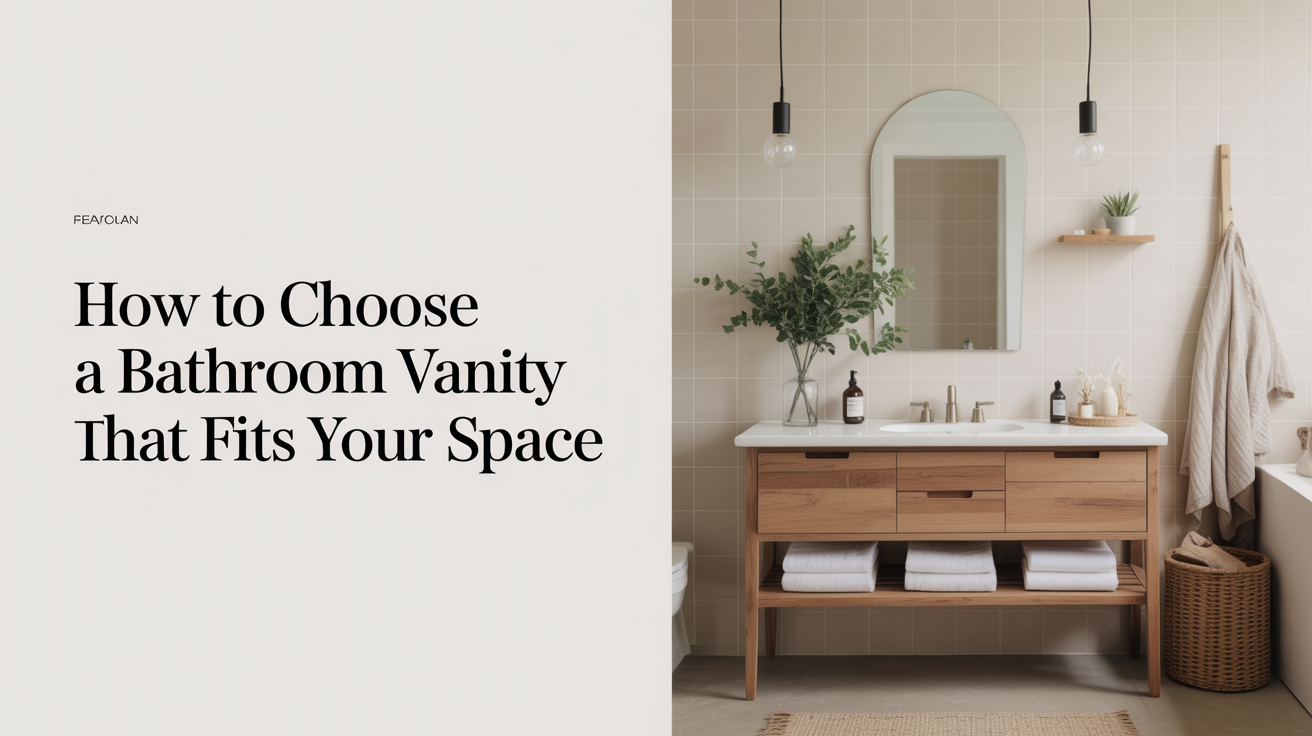
Picking the wrong vanity size is one of the most common (and expensive) bathroom mistakes. Before you fall in love with a 60-inch double sink cabinet, measure your rough-in plumbing, your door swing, and the distance to your toilet. The cabinet that fits your Pinterest board may not fit your floor plan.
At a Glance
- Measure three things before shopping: clearance to the toilet (15 in. code minimum, 18 in. comfortable), door swing clearance, and rough-in plumbing location.
- Vanity width should be worked backward from your smallest measured constraint, not chosen first.
- Depth of 21-22 inches is standard; going shallower than 18 inches trades counter space for wall clearance.
- Solid wood and plywood boxes handle bathroom humidity far better than MDF or particleboard over a 5+ year horizon.
- WaterSense-labeled faucets cap flow at 1.5 gallons per minute versus a standard 2.2 gpm, without a noticeable drop in usability.
- Floating vanities need wall blocking rated for the cabinet's weight; confirm that before you fall for the look.
Start with Your Floor Plan, Not Your Style
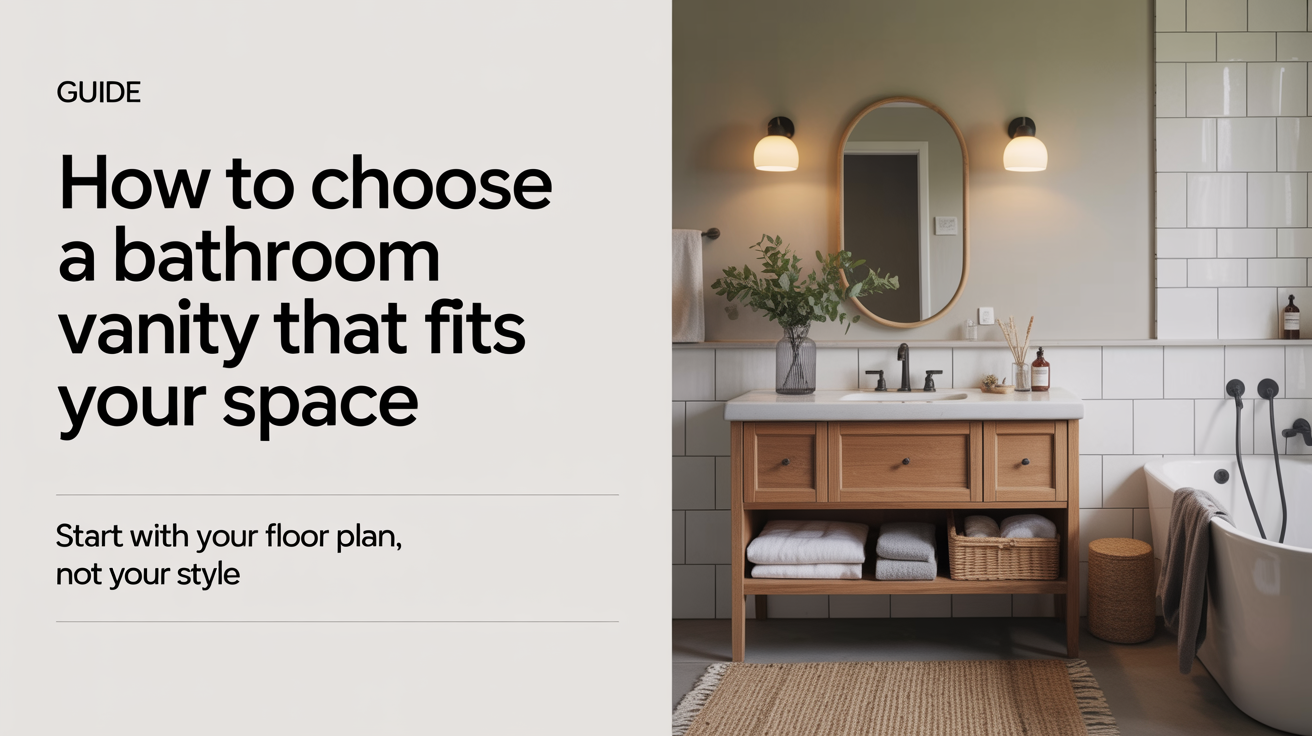
Grab a tape measure and write down three numbers before you look at a single product listing.
Clearance to the toilet. Building codes in most U.S. jurisdictions require at least 15 inches from the toilet centerline to any side obstruction (vanity, wall, tub). The comfortable minimum is 18 inches. If your toilet is closer than that, a wide vanity will make the bathroom feel cramped and may not pass inspection if you're doing a permitted remodel. Worth knowing: that 15-inch figure is a residential code minimum, not a universal standard. The U.S. Access Board's accessibility guidelines require a 60-by-56-inch clear floor space around an accessible toilet, roughly four times the footprint a standard residential layout assumes. You don't need to design to that spec in a typical remodel, but it's a useful reference if you're planning to age in place or want the bathroom to work for a wider range of users later.
Door swing and traffic path. A bathroom door that swings inward needs a clear arc. Measure from the hinge point and make sure the door clears a fully open drawer. Pocket doors and barn doors solve this problem entirely, but they add cost.
Rough-in plumbing location. Your drain and supply lines are already in the wall or floor. A centered drain lets you use almost any vanity. A drain that's 8 inches off-center limits your options, or forces you to move plumbing (a real plumber job, not a weekend project). Consult a licensed plumber before assuming you can shift supply lines.
Once you have those three numbers, you know your maximum vanity width. Work backwards from there.
Vanity Size Reference
Standard vanities come in fairly predictable widths. Here's how to match width to bathroom size:
| Vanity width | Typical bathroom size | Basin config | Approximate cost (cabinet only) |
|---|---|---|---|
| 24 in. | Small powder room or tight full bath | Single sink | $200-$600 |
| 30-36 in. | Average full bath (5x8 ft) | Single sink | $300-$900 |
| 42-48 in. | Larger bath or master bath | Single sink, wider counter | $500-$1,500 |
| 60 in. | Master bath with space to spare | Single or double sink | $700-$2,500+ |
| 72-84 in. | Ensuite or double-occupancy bath | Double sink | $1,200-$4,000+ |
Depth matters too. Most vanities are 21-22 inches deep. Some compact models go as shallow as 16-18 inches, which helps in a narrow bathroom but gives you less counter space and a smaller basin. A 21-inch vanity is the practical minimum for comfortable daily use.
Height is the other variable people often overlook. Standard vanity height is 32-34 inches (top of the basin rim). Comfort height, sometimes called "adult height," runs 36 inches. If you're tall or have back problems, the extra 2-4 inches makes a real difference over the course of a year. Just verify your mirror placement before ordering a taller cabinet.
A worked example on the width math: say your toilet centerline sits 20 inches from the side wall where you want the vanity, and your local code requires 15 inches minimum clearance. That leaves you 5 inches of buffer, meaning a vanity up to that side wall would only need to stop 15 inches from the toilet centerline. If the wall-to-wall span on that side is 42 inches and the toilet eats 15 inches of it, you have roughly 27 inches left for the vanity itself, comfortably fitting a 24-inch cabinet with an inch or two of trim gap on each side, but not the 30-inch model you had bookmarked.
For a deeper look at single vs. double configurations, including how to decide when a double vanity makes sense versus just taking up wall space, see our guide on single vs. double vanity options.
Cabinet Materials and What They Actually Mean
The finish photo looks the same whether the box is solid wood or particleboard. The difference shows up in three to five years, especially in a humid bathroom.
Solid wood (usually birch, oak, or maple) handles moisture better than engineered wood and can be refinished if the finish wears. It costs more and is heavier, which matters if your wall framing is marginal.
Plywood boxes are the middle ground. More stable than particleboard under humidity, less expensive than solid wood. Most mid-range vanities in the $500-$1,500 range use plywood boxes with solid wood drawer fronts.
MDF (medium-density fiberboard) and particleboard are common in budget cabinets. They're fine if the bathroom is well-ventilated and the finish seals every edge. The problem is cut edges near the plumbing holes, where moisture wicks in and causes swelling. If you buy an MDF cabinet, seal every cut edge before installation.
Thermofoil is MDF with a vinyl film bonded to it. It looks clean and wipes down easily. It can peel at the edges over time, particularly around heat sources.
For the countertop, your main choices are:
- Cultured marble (cast resin/marble dust): inexpensive, integrated sink, no grout lines. Scratches and stains over time; hard to repair.
- Porcelain or ceramic: durable, wide style range. An undermount sink with a porcelain top is one of the most practical combinations for daily cleaning.
- Quartz: very durable, non-porous, consistent color. More expensive ($50-$120 per sq. ft. fabricated). A good choice if you want it to last 20 years.
- Natural stone (marble, granite): beautiful, requires sealing. Marble is porous and stains from makeup, toothpaste, and acidic cleaners.
- Solid surface (Corian-type): seamless sink integration, repairable if scratched. Less heat-resistant than stone.
Cabinet Material Comparison
| Material | Moisture resistance | Cost tier | Lifespan in a humid bath | Best used for |
|---|---|---|---|---|
| Solid wood | High | High | 15-25+ years, refinishable | Long-term investment vanities |
| Plywood box | Medium-high | Mid | 12-20 years | Most mid-range full-bath vanities |
| MDF/particleboard, sealed | Medium if sealed well | Low | 5-10 years, swells at cut edges | Guest baths, budget remodels |
| Thermofoil over MDF | Medium, peels at edges/heat | Low-mid | 6-10 years | Simple styles, tight budgets |
Plumbing Connections: What to Check Before You Order
The vanity has to work with your existing plumbing, or you have to change your plumbing to suit the vanity.
P-trap clearance. The drain pipe connects to a P-trap inside the cabinet. If the drain rough-in is high on the wall (say, 18-20 inches off the floor), a shallow cabinet or a vessel-sink setup may be your only option. If the drain is low, you have more flexibility.
Supply line shutoffs. Hot and cold supply lines should have shutoff valves. If yours don't, add them while the wall is open. This is straightforward work for a plumber and saves enormous hassle later.
Vessel sinks vs. undermount vs. drop-in. Vessel sinks sit on top of the counter. They look dramatic but raise your basin height significantly (often 6-8 inches above the counter), which can make the whole vanity too tall for shorter users. Undermount sinks are mounted below the counter surface, which makes cleaning easy. Drop-in (self-rimming) sinks are simpler to install because they don't require a perfectly finished counter edge.
Check the faucet hole configuration too. A widespread faucet (handles 6-8 inches apart, center-set 4 inches apart) requires pre-drilled holes in the right positions. If you're buying a separate countertop, make sure the drilling matches your faucet. Our guide to bathroom faucet types covers hole configurations and flow rates in detail. On the flow-rate question specifically, it's worth choosing a WaterSense-labeled faucet: those are capped at a maximum of 1.5 gallons per minute compared to a standard faucet's 2.2 gpm, a 30 percent or larger cut in water use with no drop in day-to-day usability, and the EPA estimates the switch saves a typical household around 700 gallons a year.
Always consult a licensed plumber before moving supply lines or the drain rough-in. What looks like a simple shift can involve opening walls, re-routing vent stacks, or working around existing framing, none of which is a DIY judgment call.
Style and Finish: Keeping It Cohesive
A vanity doesn't exist in isolation. It needs to read well next to the floor tile, the shower enclosure, and the hardware already on your door and towel bars.
A few practical rules:
- Decide on a metal finish (brushed nickel, matte black, polished chrome, brass) before you buy the vanity. Then buy everything else in that finish or a deliberate contrast. Mixing chrome and brushed nickel by accident looks unfinished.
- If your tile is busy (patterned, colorful, large-scale), a simpler vanity cabinet tends to balance the room. A highly detailed shaker cabinet with carved hardware competes with bold floor tile.
- Floating (wall-mounted) vanities make a small bathroom feel larger because the floor reads as continuous. They require solid blocking in the wall to support the weight. If you don't have blocking, a contractor needs to open the wall to add it before mounting.
- Light-colored cabinets (white, light gray, linen) reflect more light. That's useful in a windowless bathroom. Dark cabinets are handsome but absorb light, so pair them with good lighting.
If you're planning a full bathroom overhaul that includes a new shower as well, it helps to think about the vanity and shower as part of the same visual palette. Our piece on walk-in shower features and ideas covers material and finish choices that translate well across both.
Frequently Asked Questions
What is the minimum clearance needed between a vanity and a toilet?
Most U.S. building codes require 15 inches from the toilet centerline to any side obstruction. For comfortable daily use, 18 inches is the realistic minimum. If your bathroom falls below that, you'll likely need a narrower vanity or a different toilet placement. Check your local code before purchasing, because requirements vary by jurisdiction.
What height vanity should I buy?
Standard vanity height (top of the rim) is 32-34 inches. Comfort height is 36 inches. Most adults find the comfort height easier on the back. If multiple people of different heights share the bathroom, 34-35 inches is a reasonable compromise. Children's bathrooms typically stay at 32 inches.
Can I replace just the vanity cabinet and keep the countertop?
Sometimes. If the existing countertop overhangs the cabinet uniformly and the mounting points line up, a cabinet swap can work. More often the countertop was made for the specific cabinet width and won't fit a different size. Measure carefully and be prepared to replace the top too.
What's the difference between a freestanding, wall-mounted, and pedestal vanity?
Freestanding (floor-standing) vanities rest on legs or a full base and are the most common and easiest to install. Wall-mounted (floating) vanities are anchored to the wall with no floor contact, which is visually clean and makes mopping easier, but requires blocking in the wall. Pedestal sinks have no storage at all, they're good for very small bathrooms or powder rooms where storage can go elsewhere.
How do I know if a vanity will fit through my bathroom door?
Measure your door opening width (not the door itself, the rough opening). Most vanities over 36 inches wide ship as separate pieces (cabinet and top) for this reason. A 60-inch vanity cabinet is typically split at the center for shipping and installation. Check the manufacturer's assembly instructions before you assume it arrives ready to slide in.
How much weight can a floating vanity actually hold?
It depends entirely on the wall blocking, not the cabinet itself. A properly blocked wall (solid lumber or steel backing installed between the studs at the mounting height) can support 200-400 pounds or more, plenty for a stone countertop and daily use. Without blocking, you're relying on drywall anchors, which are rated for a fraction of that and are not appropriate for a full vanity installation. If you're retrofitting a floating vanity into an existing wall, budget for opening the drywall to add blocking rather than trusting heavy-duty anchors alone.
Is it worth paying more for a soft-close hinge and drawer system?
For daily-use bathrooms, generally yes. Soft-close hardware costs $20-$60 more per vanity but eliminates the slammed-door wear that loosens hinges and chips finish over a few years, and it matters more in a bathroom than almost anywhere else in the house because doors and drawers get opened one-handed, often while wet. It's a low-cost upgrade relative to the total price of the cabinet.