Tile & Flooring
Heated Bathroom Floors: Cost, Pros, and How They Work
A plain-language guide to heated bathroom floors: how radiant systems work, what they cost installed, and whether underfloor heating is worth it.
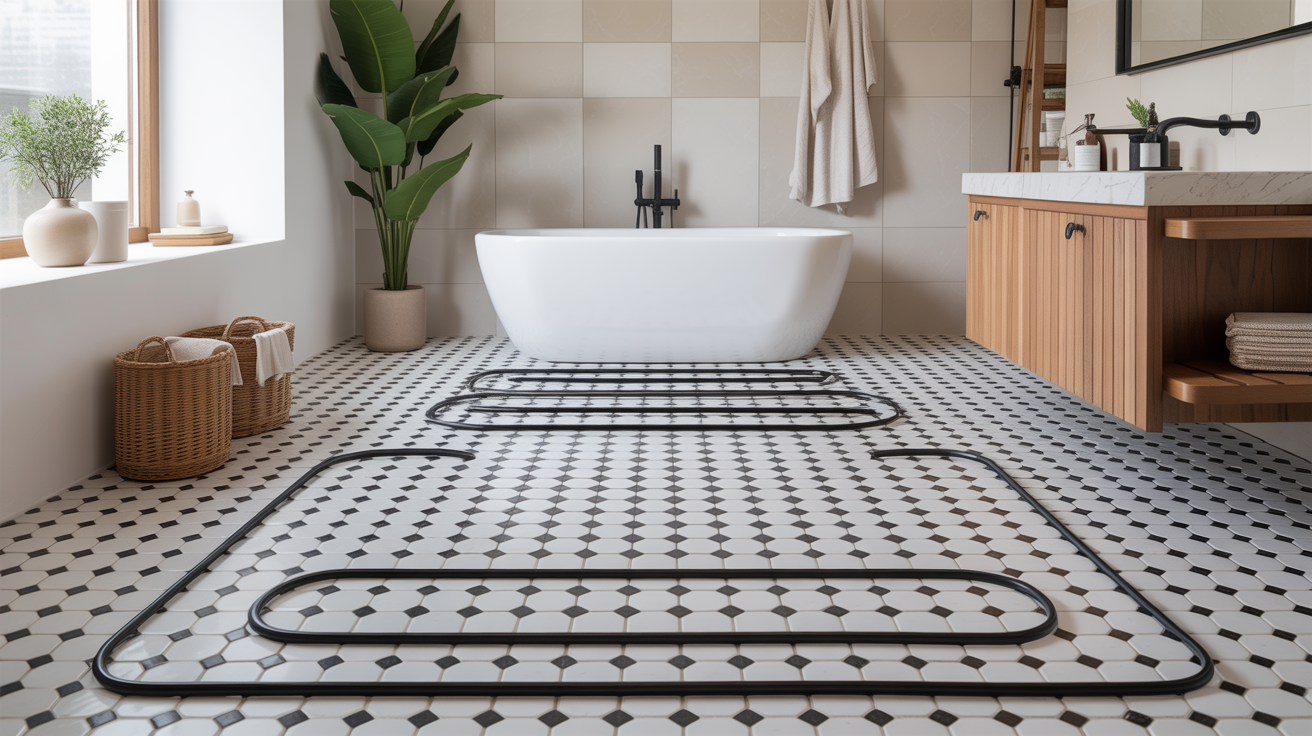
Stepping out of the shower onto a cold tile floor is one of those small but reliable annoyances of daily life. A heated bathroom floor solves that, and it does it without any visible hardware. The heat source lives beneath the tile, warming the surface from below so the floor sits at a comfortable 75°F to 85°F (24°C to 29°C) instead of the chilly 55°F to 65°F (13°C to 18°C) that tile can reach on a cold morning.
This guide covers how the two main types of underfloor heating actually work, what a realistic budget looks like, and what you should know before committing to the project.
At a Glance
- Electric radiant systems are the practical choice for a single bathroom; hydronic systems rarely make sense unless the whole house already runs on one.
- A typical 50 sq ft bathroom with electric radiant heat, installed as part of a retile, runs $1,000 to $2,000 all-in.
- The mat itself is thin (about 1/8 inch), but the electrical hookup requires its own permit and a licensed electrician in most jurisdictions.
- Expect to add roughly $10 to $15 per month to your electric bill running the system on a morning schedule.
- Porcelain and ceramic conduct heat most predictably; thick natural stone reads cooler at the surface for the same mat output.
- A quality mat is rated for 20 to 30 years, so buying one with a strong warranty matters more than shaving a few dollars per square foot.
How a Heated Bathroom Floor Works
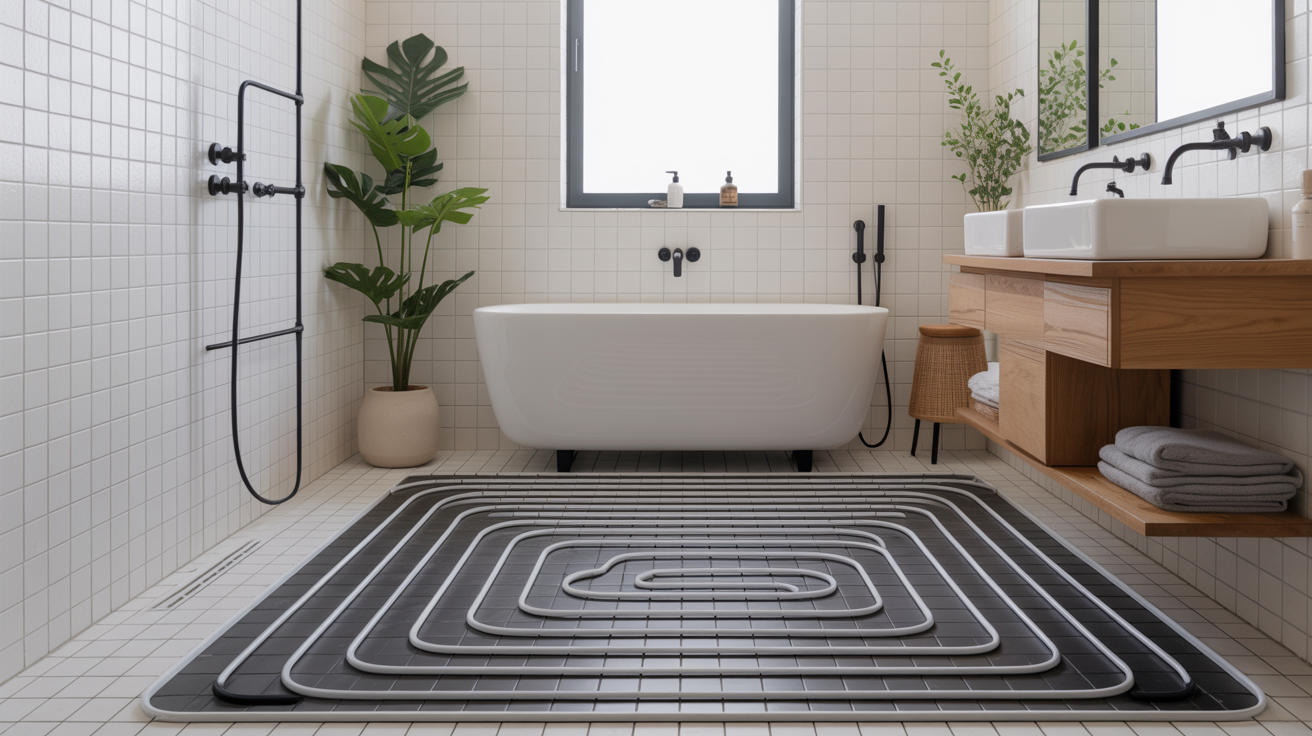
Radiant floor heating transfers warmth directly through conduction. Instead of heating the air (the way a forced-air vent does), the system heats the floor surface itself, and that warmth radiates upward through the room at floor level where you actually feel it. Bathrooms are the most popular application because the rooms are small, the tile is already in place, and the payoff is immediate. As a category, underfloor heating is broadly split into electric and hydronic systems, a distinction Wikipedia's overview of radiant heating confirms is the standard way the industry classifies these installations.
There are two types of systems. They work on the same principle but use completely different heat sources.
Electric Radiant Systems
Electric systems use a thin heating mat or loose resistance cable embedded in the mortar bed just below the tile. The mat plugs into a dedicated electrical circuit (typically 120V or 240V), and a programmable thermostat controls when it runs. Most mats are only about 1/8 inch (3 mm) thick, so they add almost nothing to the floor height.
For a bathroom, electric is usually the right choice. Installation is straightforward for a tile contractor who has done it before, the mats are easy to cut and shape around fixtures, and the project can be scoped to one room without touching the home's heating system. The downside is operating cost: electricity is more expensive per BTU than natural gas, so these systems cost more to run day-to-day than hydronic alternatives.
Hydronic Systems
Hydronic underfloor heating circulates hot water through flexible PEX tubing beneath the floor. A boiler heats the water, a pump moves it through the loops, and manifolds distribute flow to each zone. Hydronic is cheaper to operate long-term but costs far more to install. Adding a hydronic loop to a single bathroom that is not already connected to a whole-home system rarely pencils out. For a bathroom-only retrofit, electric is almost always the practical path.
Heated Tile Floor Cost: What to Budget
Costs vary based on bathroom size, your region, and whether the floor is already being retiled. Here are the numbers you are most likely to encounter.
Material and Mat Costs
Electric heating mats typically run $8 to $15 per square foot for the mat itself. A 50 sq ft bathroom (roughly 7 x 7 ft) would need $400 to $750 in mat materials. Loose cable kits cost a bit less but take longer to install. You will also need a compatible programmable thermostat, which adds $50 to $200 depending on features.
Hydronic tubing is cheaper per foot, but the pump, manifold, and boiler integration push total material costs well past $2,000 for even a small bathroom.
Labor and Installation
Electric mat installation adds roughly $200 to $500 to what you would already pay for tiling. An experienced tile installer can embed the mat, apply self-leveling compound, and set tile in a day or two. The electrical connection (running the circuit and wiring the thermostat) is usually done by a separate electrician and costs $100 to $400 depending on whether a new circuit is required.
Putting it together, a typical 50 sq ft bathroom with electric radiant heat installed runs $1,000 to $2,000 all-in, including tile and labor. That number rises if the bathroom needs new tile anyway, or drops if you are a confident DIYer handling the mat installation yourself (the electrical work should still be done by a licensed electrician in most jurisdictions).
Hydronic installation in a single bathroom, starting from scratch, often runs $5,000 to $10,000 or more. Most homeowners only go hydronic when the project is part of a larger renovation.
Cost Comparison by Bathroom Size
Mat and material pricing scales roughly linearly with square footage, but the fixed costs (thermostat, electrical hookup) stay flat, so smaller bathrooms carry a higher cost per square foot.
| Bathroom Size | Mat Material Cost | Electrical + Labor | Total Installed (Electric) |
|---|---|---|---|
| 25 sq ft (powder room) | $200 to $375 | $350 to $700 | $650 to $1,300 |
| 50 sq ft (standard) | $400 to $750 | $350 to $900 | $1,000 to $2,000 |
| 80 sq ft (primary bath) | $640 to $1,200 | $400 to $1,100 | $1,300 to $2,800 |
| 120 sq ft (large primary) | $960 to $1,800 | $450 to $1,300 | $1,700 to $3,800 |
Pros and Cons Worth Knowing
What You Gain
The obvious benefit is comfort. Tile stores cold aggressively, and a heated bathroom floor removes that entirely. The floor surface reaches temperature quickly, especially with electric mats, which heat up in 30 to 60 minutes and can be set to a schedule so the floor is warm when you wake up.
There are secondary benefits too. Radiant heat dries the floor faster after a shower, which reduces the standing moisture that mold and mildew need to establish themselves. That lines up with the EPA's core guidance on moisture control: getting a wet surface dry within 24 to 48 hours is one of the most effective ways to prevent mold, and a warm floor gets there faster than a cold one left to air-dry on its own. The system is silent and has no moving parts that wear out. Programmable thermostats let you set the floor to 80°F (27°C) at 6 a.m., drop back at 8 a.m. when everyone leaves, and shut off automatically. Some models connect to a home automation system.
Where It Falls Short
Electric radiant heat costs more per month to run. For a 50 sq ft bathroom, expect to add roughly $5 to $15 per month to your electric bill depending on how many hours per day it runs and your local electricity rate. That number stays manageable if you use the thermostat's schedule rather than running the system constantly.
The other issue is compatibility. You cannot install a heating mat under laminate or thick hardwood. The system works best under tile or stone, and reasonably well under thin LVP that is rated for radiant heat. If you are planning to use a thick natural stone tile (3/4 inch or more), check that the thermostat's sensor can accurately read temperature through that much material.
Mat installation is permanent. If something goes wrong with the mat itself (which is rare, but possible), access means pulling up tile. Buying a mat from a manufacturer that includes a warranty of 25 years or more is worth the extra cost for this reason.
The Electrical Side Is Not Optional
A heated floor mat draws real current, and it sits in a room with plumbing fixtures, standing water, and high humidity. That combination is exactly why bathroom circuits carry the strictest ground-fault protection requirements in residential wiring: bathrooms have required GFCI protection on their receptacles since 1975, and current code extends that protection to any 125-volt receptacle within 6 feet of a tub or shower, per the summary on Wikipedia's National Electrical Code page. A heated-floor circuit needs its own dedicated breaker, often with ground-fault protection built in at the panel or the thermostat itself, which is one of the main reasons this step should not be a DIY shortcut even for an otherwise confident homeowner.
Choosing the Right Tile for a Heated System
Not every tile performs the same over a heating mat. The material affects how efficiently heat transfers to the surface and how the tile handles repeated thermal cycling.
Porcelain and ceramic are the standard choices. Both conduct heat well and handle expansion and contraction without cracking. Porcelain is denser and holds heat slightly longer after the mat shuts off. The guide to how to choose bathroom floor tile that lasts covers thickness, PEI rating, and slip resistance in detail.
Natural stone (marble, travertine, slate) also works well thermally, but it is more porous and needs to be sealed before installation. Thicker slabs transfer heat more slowly and may read lower temperatures at the surface.
Large-format tiles (24 x 24 in or larger) need a slightly thicker mortar bed to maintain contact with the mat. Your installer should use a heated-floor-compatible thinset and confirm the mat is fully embedded without air gaps, since air pockets cause hot spots that can damage both the mat and the tile above.
What the Installation Process Looks Like
If you are retiling an existing bathroom, the sequence runs like this:
- Remove existing tile and any damaged substrate. The subfloor needs to be structurally sound and flat (within 3/16 in per 10 ft).
- Install cement backer board or a similar uncoupling membrane rated for radiant heat.
- Lay out the heating mat, cutting and routing it to fit around the toilet base, vanity, and any other fixed obstacles. The mat should not go under cabinetry or behind the toilet where it would waste energy heating inaccessible space.
- Secure the mat with thinset or the manufacturer's tape, and run the thermostat's temperature probe between the mat's heating cables (not on top of them).
- Cover with self-leveling compound if needed to eliminate height differences, then set tile with a thinset rated for heated floors.
- Connect the mat to the thermostat and the thermostat to the dedicated circuit. Use an ohmmeter to verify the mat's resistance matches the manufacturer's specification before and after tiling.
For a broader look at how different materials hold up in wet conditions, the best flooring for bathrooms guide has a full comparison.
Frequently Asked Questions
How warm does a heated bathroom floor actually get?
Most thermostats for electric mats cap out at 82°F to 104°F (28°C to 40°C) at the floor surface. For comfort, most people set them between 75°F and 85°F (24°C to 29°C). The thermostat's sensor reads the subfloor temperature, so the tile surface will feel slightly cooler than the set point.
Can I install a heated floor mat myself?
The mat installation itself is within reach for a careful DIYer who is already retiling. The electrical connection is separate. Wiring a new 120V or 240V circuit and connecting the thermostat requires a permit and a licensed electrician in most jurisdictions. Some areas allow homeowners to pull their own permits; check with your local building department before starting.
Will a heated floor raise my electric bill significantly?
A 50 sq ft bathroom mat typically draws 500 to 750 watts. Running it for three hours per day at $0.15 per kWh costs roughly $2.25 to $3.40 per week, or $10 to $15 per month. Using a programmable thermostat to run the system only during morning hours keeps operating costs reasonable.
Does the heating mat affect tile installation?
It adds one step to the process. The mat needs to be embedded in thinset before tile goes down, and the temperature probe has to be positioned correctly in the mortar bed. Installers experienced with radiant heat handle this routinely. The only real risk is a mat that gets cut or kinked during installation. Check continuity with an ohmmeter before pouring any compound or setting tile.
How long do electric heating mats last?
Most manufacturers rate their mats for 20 to 30 years. The heating cable has no moving parts and rarely fails on its own. The thermostat is the component most likely to need replacement, typically after 10 to 15 years. Keep the wiring diagram and mat layout photo on file so any future thermostat swap is straightforward.
Is a heated floor worth it in a cold climate versus a mild one?
The comfort payoff is bigger in a cold climate, where tile can drop into the low 50s Fahrenheit overnight, but the running cost is also higher because the thermostat calls for heat more often and for longer stretches. In a mild climate, the mat may only need to run an hour or two on the coolest mornings, which keeps monthly cost closer to the low end of the range. Either way, the system pays off most in bathrooms used daily, first thing in the morning, rather than guest bathrooms used occasionally.
Can I add a heated floor to an existing bathroom without retiling everything?
Not really. The mat has to sit directly beneath the tile, in the mortar bed, so retrofitting one under tile that is staying in place is not practical. If the floor tile is due for replacement anyway, the incremental cost of adding a mat during that project is modest, which is why most heated floors get installed as part of a retile rather than as a standalone upgrade.