Tile & Flooring
Porcelain vs Ceramic Tile: Which Is Better for Bathrooms
Porcelain vs ceramic tile for bathrooms and showers: how absorption rates, costs, and hardness differ, and where each one actually belongs.
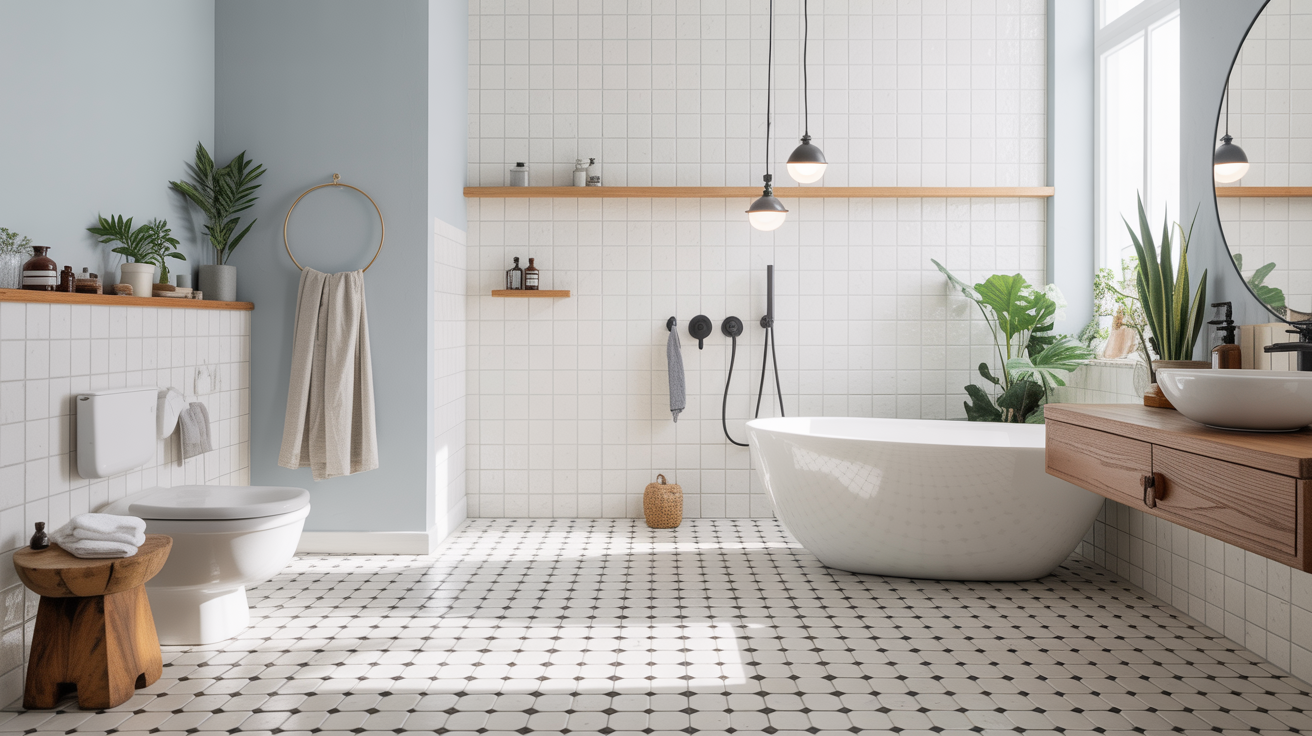
Both porcelain and ceramic tile are clay-based, kiln-fired, and widely available at any tile retailer. They look similar on a display wall. But the material differences matter in a bathroom, where one wall might get daily direct water contact and the floor needs to hold up to decades of wet feet. Knowing which type belongs where saves you from an expensive redo down the road.
At a Glance
- Porcelain absorbs less than 0.5% water by weight; ceramic typically absorbs 0.5% to 3%. That gap drives almost every other difference between them.
- Porcelain is the safer default for shower floors, shower walls, and any surface with sustained water contact.
- Ceramic is a reasonable, budget-friendly choice for walls above the splash zone and for low-traffic guest bathrooms.
- Large-format tile (above 15 x 15 inches) is almost always porcelain because it holds up better during firing and installation.
- Both materials need a latex-modified thinset in wet areas; the actual waterproofing comes from the membrane behind the tile, not the tile itself.
- Ceramic typically costs 20% to 40% less per square foot than comparable porcelain, which adds up fast across a full tub surround.
What Actually Separates Them
The split comes down to clay composition and firing temperature.
Ceramic tile uses a general-purpose clay body with a glaze applied to the surface before firing. The kiln runs at roughly 1,900°F (1,040°C). That leaves the finished tile slightly porous, with a water absorption rate that typically falls between 0.5% and 3%.
Porcelain uses a finer, denser clay (often blended with feldspar or quartz) and fires at higher temperatures, usually 2,300°F to 2,400°F (1,260°C to 1,315°C), consistent with the roughly 1,200°C peak kiln temperatures used industry-wide to vitrify porcelain tile. The extra heat vitrifies the clay body more thoroughly, producing a tile with a water absorption rate below 0.5%. That 0.5% threshold is the standard the American National Standards Institute (ANSI) uses to define porcelain. Below it, the tile body is nearly impermeable.
Why the Absorption Rate Matters in a Bathroom
A bathroom sees humidity cycles every day. Shower floors and walls get direct water contact for minutes at a time. A tile that absorbs too much moisture can eventually weaken its adhesive bond, support mold growth behind grout lines, or develop subsurface problems that don't appear until tiles start to pop loose.
Below the 0.5% absorption threshold, water management responsibility shifts to the grout and the installation rather than the tile itself. That's where it belongs, because grout and membranes can be addressed during installation in ways that a porous tile body cannot.
Where Porcelain Makes More Sense
Porcelain is the stronger choice anywhere that sees prolonged or direct water exposure.
Shower Walls and Floors
For shower surrounds and shower floors, porcelain tile is the standard recommendation. The low absorption rate means standing moisture does not penetrate the tile body. If you're building a walk-in shower or tiling a full wet room, starting with a verified porcelain (water absorption figure below 0.5% on the spec sheet) removes one variable from a complex installation.
For shower floors specifically, choose a matte or textured finish. Polished or glossy porcelain looks sharp on walls but becomes dangerously slippery underfoot when wet. Look for a COF (coefficient of friction) of 0.42 or higher for floors, and confirm the wet COF rating if the spec sheet includes it. Even federal accessibility guidance sidesteps a single hard number here: the U.S. Access Board notes that ADA standards don't set a minimum COF because no consensus test method exists, and instead just require that a floor surface be "stable, firm, and slip resistant" for the conditions it will see. In practice, that means the ANSI A137.1 wet-COF rating on the tile spec sheet is your best objective reference point, even without a single universal legal minimum behind it.
High-Traffic Bathroom Floors
Porcelain is harder than ceramic, which shows up in PEI (Porcelain Enamel Institute) wear ratings. Most residential bathroom floors need a tile rated PEI 3 or 4. Porcelain tiles commonly meet that threshold. Ceramic is softer and can chip or show wear faster on a busy family bathroom floor, particularly near the door where grit gets tracked across the surface daily.
Large-Format Tiles
Large-format tiles (anything above 15 x 15 inches, and especially 24 x 24 inch panels) are almost always porcelain. The higher firing density gives large pieces the structural integrity to resist warping during manufacturing. Ceramic in large formats is uncommon for that reason.
Where Ceramic Is a Reasonable Choice
Ceramic's reputation suffers from comparison to porcelain in situations where porcelain's advantages don't really apply.
Bathroom Walls Above the Splash Zone
Ceramic works well on walls that stay outside the direct spray path: the wall behind a toilet, an accent row above wainscoting, or a vanity backsplash. The glaze fired onto the surface renders the earthenware impermeable to water by sealing the porosity of the clay body underneath, and that thin glassy layer does the actual water-resisting work on ceramic tile. The porous clay body below the glaze only becomes a problem if the glaze is chipped or the grout cracks and stays cracked. Good installation and periodic grout sealing manage that risk on low-contact walls, regardless of tile material.
Guest Bathrooms and Low-Use Spaces
A powder room used mainly by guests sees a fraction of the moisture a primary shower does. Ceramic floor tile rated PEI 3 performs well in those conditions for years. It also comes in a wider variety of decorative finishes at lower prices, which matters when a space is less critical and the budget is tighter.
Budget-Conscious Projects
Ceramic typically costs 20% to 40% less per square foot than comparable porcelain. For a tub surround in a secondary bathroom, that gap adds up meaningfully across 80 to 100 square feet of wall. As a worked example: at $4 per sq ft for ceramic versus $6.50 per sq ft for a comparable porcelain, an 90 sq ft surround runs about $360 in ceramic tile versus $585 in porcelain, a $225 difference before labor. On a low-splash wall, that's real money that doesn't buy you a meaningful durability gain. If the installation is correct (proper cement board backer, appropriate thinset, sealed grout), ceramic in lower-moisture applications performs reliably.
A Side-by-Side Look
| Feature | Ceramic | Porcelain |
|---|---|---|
| Water absorption | 0.5% to 3% | Below 0.5% |
| Hardness (PEI) | Moderate | Higher |
| Weight per sq ft | Lighter | Heavier |
| Typical cost | Lower | Higher |
| Best for showers | Walls above spray zone | Walls and floor |
| Large formats | Less common | Standard |
| DIY cuttability | Score-and-snap possible | Requires diamond wet saw |
Where to Use Each Material by Bathroom Zone
| Bathroom Zone | Recommended Material | Why |
|---|---|---|
| Shower floor | Porcelain | Constant water contact; needs COF 0.42+ |
| Shower walls, lower 24-36 in | Porcelain | Highest and most sustained spray exposure |
| Shower walls, upper section | Either | Indirect spray; glaze protects ceramic adequately |
| Primary bathroom floor | Porcelain, PEI 3-4 | Daily wet feet and higher foot traffic |
| Powder room or guest bath floor | Ceramic, PEI 3, is fine | Low use; budget matters more here |
| Backsplash or accent wall | Either | No sustained water contact |
| Large-format (24 x 24 in+) | Porcelain | Structural stability during firing and install |
Installation Differences Worth Knowing
Cutting and Tool Requirements
Porcelain's density makes score-and-snap cutting impractical for most cuts. A wet saw with a diamond blade is standard equipment for porcelain work. Ceramic gives more flexibility: a manual snap cutter handles straight cuts cleanly, though a wet saw still produces better results around fixtures and niches.
For a DIY project involving detailed cuts around a shower valve or built-in niche, porcelain demands more patience and better tooling. Budget extra time.
Thinset and Coverage Requirements
Both materials require a latex-modified thinset rated for wet areas. Standard mastic adhesive is not appropriate in any shower, regardless of tile type. It softens with moisture.
For large-format porcelain tiles, manufacturer instructions often call for back-buttering (applying thinset to the back of each tile in addition to the substrate). The goal is 95% contact coverage behind the tile in a wet installation. Low contact coverage leaves voids where water can sit and eventually cause problems.
Substrate and Waterproofing
Tile does not waterproof a shower on its own. The waterproof layer belongs at the substrate, behind the tile. Cement board provides the rigid base, but a waterproof membrane, either sheet-applied or liquid-applied, is the actual water barrier. The tile sits in front of that system. See how to tile a shower wall for the full installation sequence, including membrane options and thinset coverage targets.
Frequently Asked Questions
Can I use ceramic tile in a shower?
Ceramic tile is acceptable on shower walls, particularly in areas that see indirect spray rather than direct water. The glaze protects the tile face, and proper grout sealing handles the joints. The risk comes from grout cracks that go unnoticed and unrepaired, allowing moisture to reach the porous clay body below the glaze. Most tile professionals prefer porcelain for shower floors and the lower 24 to 36 inches of shower walls, where sustained water contact is highest.
How do I confirm a tile is actually porcelain?
Check the manufacturer's technical specification sheet rather than the box label. Some tiles are marketed as "porcelain-look" or "porcelain finish" while being ceramic underneath. Look for a water absorption figure listed as below 0.5% in the technical data. If the spec sheet doesn't include absorption data, ask the retailer for it before purchasing. The number tells you more than any label.
Is porcelain harder to tile yourself than ceramic?
In practice, yes. Porcelain is denser, heavier, and requires a wet saw with a diamond blade for clean cuts. Ceramic is more forgiving, especially for straight cuts where a snap cutter works. For a large-format porcelain floor project, expect the process to take longer and require more attention to back-buttering for proper adhesion.
Does glazed porcelain need to be sealed?
Glazed porcelain does not need sealing. Unglazed porcelain (common in matte and textured floor tiles) benefits from a penetrating sealer applied before grouting and refreshed every few years. The grout, regardless of tile type, should always be sealed. Grout is far more porous than either tile material and is the more likely entry point for moisture over time. For a broader look at flooring options and their trade-offs, see best flooring for bathrooms and what to avoid.
What tile thickness should I use for a bathroom floor?
Most residential floor tiles run 3/8 inch (9 to 10 mm) thick or slightly more. Thinner tiles, around 6 mm, are designed for wall applications or for overlaying existing tile. Using a wall tile on the floor is a common mistake that shows up at the tile store when prices look unusually low. Always confirm the tile's rated application on the spec sheet before buying, particularly if the price seems better than expected.
Is porcelain tile noticeably heavier, and does that matter for the floor structure?
Yes, porcelain typically runs 5 to 10% heavier per square foot than ceramic because of its denser, more vitrified clay body. For a standard residential subfloor built to normal code loads, that difference is not a structural concern for a typical bathroom footprint. It matters more for large-format porcelain on upper floors of older homes with undersized joists, or for very large single-piece slab tile, where a contractor should confirm the subfloor can carry the load before installation, not after the tile is set.