Small Bathrooms
Small Bathroom Ideas to Make It Feel Bigger
Practical small bathroom ideas that create the illusion of space—layout tricks, fixture swaps, and design choices that actually work in tight footprints.
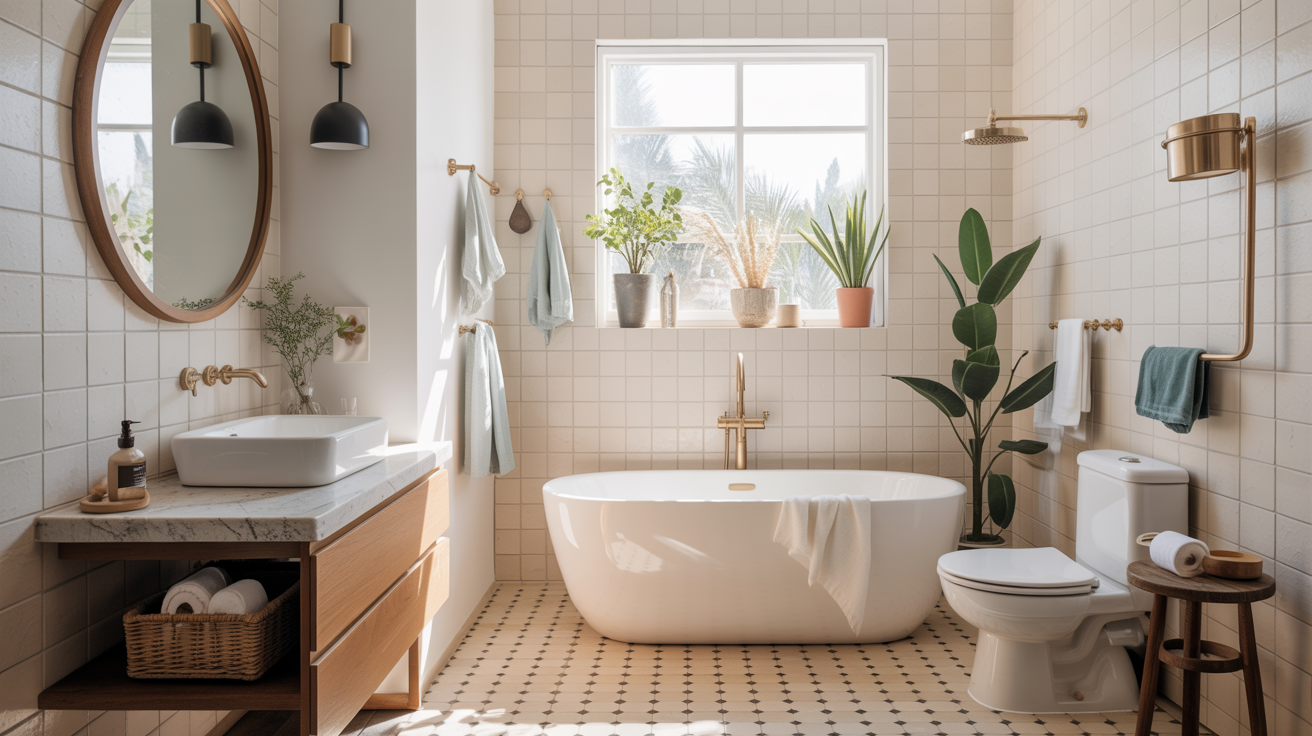
A small bathroom doesn't have to feel like a closet with plumbing. The right fixture choices and a few visual tricks can make a 5x8 ft room read as significantly larger without moving a single wall.
At a Glance
- Layout comes before decor: door swing, fixture placement, and traffic flow determine how spacious a room feels more than paint color does.
- Large-format tile (12x24 in. or bigger) run continuously from floor to shower wall erases the visual boundary that makes a room read as smaller.
- A floating vanity showing 4-6 in. of visible floor underneath is one of the highest-impact single swaps for a tight bathroom.
- Side-mounted sconces at eye level beat a single overhead fixture for eliminating shadows and making the room feel brighter.
- Minimum clearances (toilet, vanity, shower entry) are governed by local code, not personal preference; confirm them before you order fixtures.
- A full-width, edge-to-edge vanity mirror reflects more of the room's depth than a small decorative mirror and costs little extra.
Start with the Layout Before You Touch Anything Else
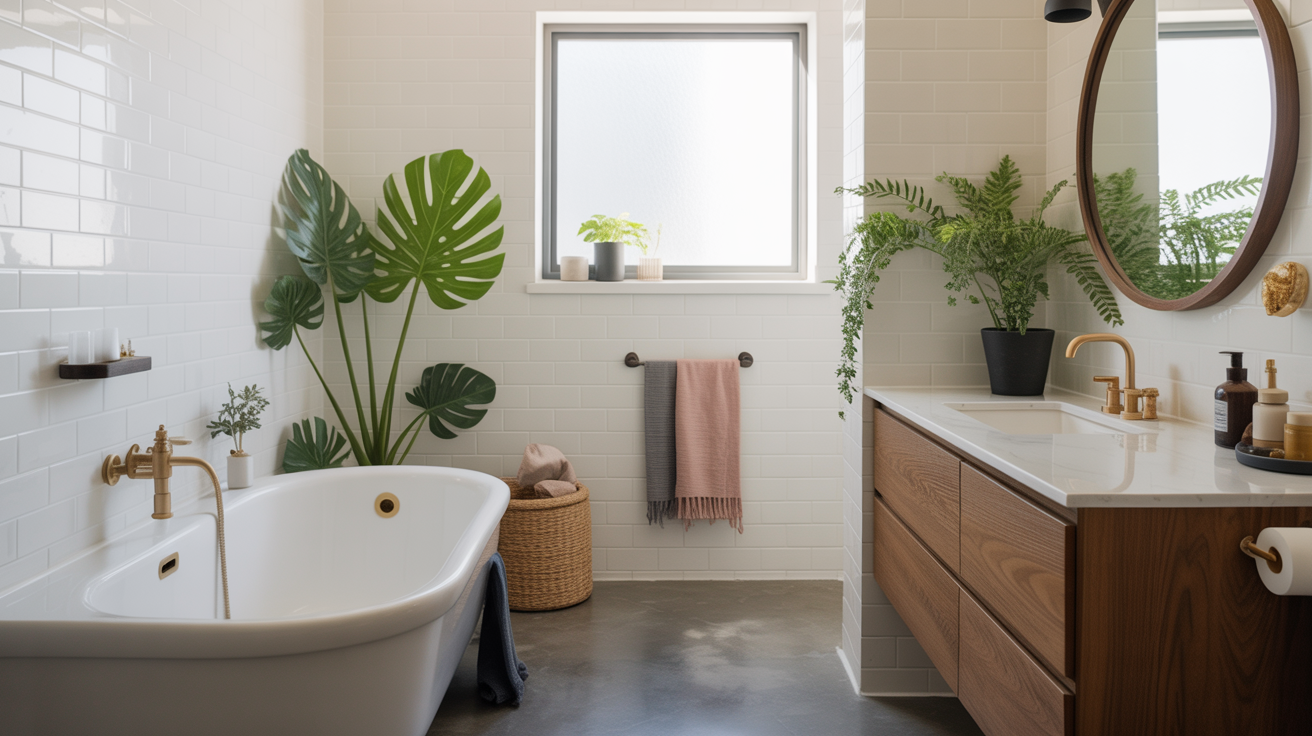
Most tiny bathroom ideas fail not because of color choices or accessories, but because the bones are wrong. A 5x8 ft bathroom (the most common American full-bath footprint) typically gives you about 40 square feet to work with. That's enough for a functional, comfortable room if the layout respects traffic flow and doesn't waste floor space on oversized fixtures.
Before buying anything, sketch where the toilet, vanity, and tub or shower land relative to the door swing. A door that opens inward and clips the toilet or vanity kills the sense of space immediately. If you're doing any remodeling, flipping to a barn-style sliding door or a 24 in. pocket door can recover 4 to 6 square feet of usable floor area.
For layout guidance specific to tight rooms, see the best layouts for a small bathroom, which covers corner shower placements and single-wall vs. galley configurations in more detail.
Minimum clearances worth knowing
These are general guidelines based on common practice. Always confirm with your local building department, as codes vary.
- Toilet centerline to side wall or fixture: 15 in. minimum, 18 in. preferred
- Toilet centerline to opposite wall: 21 in. minimum clear (30 in. preferred)
- Shower entry clearance: 24 in. minimum
- Vanity approach: 21 in. minimum in front
Those toilet centerline numbers aren't arbitrary. The U.S. Access Board's toilet room guidelines specify a 16-to-18-inch centerline for accessible installations, which is why 18 inches (rather than the bare 15-inch minimum) is worth building toward when your layout allows it: it lines up with a dimension that's already proven comfortable across a wide range of users, not just a code floor.
For comparison, accessible-design standards ask for considerably more room elsewhere in the bathroom. The U.S. Access Board's bathroom guidelines call for 30 in. wide by 48 in. deep of clear floor space in front of a lavatory for forward wheelchair approach, and a 34 in. maximum counter height. Those figures aren't your local residential code and you don't need to hit them in a standard remodel, but they're a useful upper bound: if you're already tight against the 21 in. residential minimum, you know there's no slack left to give up later for a different fixture.
Shaving even a couple inches off these by choosing a wall-mounted toilet (which projects roughly 2 in. less into the room than a floor-mount) or a compact elongated bowl (26 in. rough-in depth vs. a standard 28-30 in.) adds breathing room that's immediately noticeable.
Choose Fixtures That Don't Eat the Room
Fixture scale is where most small bathroom design projects go wrong. A 60 in. double vanity sounds appealing on paper. In a 5x8 room, it leaves you roughly 36 in. of clearance to the opposite wall. That's tight, and it's below the 48 in. of clear approach space that accessible-design guidelines recommend for comfortable forward access, which is a decent proxy for "does this feel cramped when someone's actually standing at the sink."
Vanity swaps that make a real difference
A 24 in. or 30 in. single vanity with a wall-mounted faucet and an undermount sink opens up counter space and keeps the visual line clean. If storage is the concern, go vertical: a 24 in. wide vanity paired with a floor-to-ceiling linen cabinet at the end of the run gives more actual storage than a wide sprawling base cabinet, and it draws the eye up.
Floating vanities (wall-mounted, with no legs or base cabinet touching the floor) are one of the most effective small bathroom ideas in practice. Showing 4 to 6 in. of floor beneath the vanity makes the room read wider. Pair it with a large-format floor tile running continuously under the vanity and you amplify that effect further.
Shower vs. tub in tight spaces
A standard tub is 60 x 30 in. and accounts for half the floor area of a 5x8 room. If you're not actually using the tub, replacing it with a 36 x 36 in. corner shower or a 32 x 60 in. walk-in shower (same footprint as the tub, no threshold) opens the room considerably. A doorless, curbless shower with a linear drain reads as part of the floor plane rather than a boxed-off zone.
If you need to keep the tub, a clear glass shower door instead of a frosted panel or shower curtain makes a significant difference. The eye can travel through to the wall behind, which reads as more space.
Use Tile and Color to Make Small Bathrooms Look Bigger
Color does matter, but not in the way most people expect. The goal isn't to paint everything white. It's to minimize visual interruptions.
Tile choices that open up space
Large-format tiles (12x24 in. or 24x24 in.) have fewer grout lines than small mosaic tiles, which means fewer visual breaks across the floor and walls. Fewer breaks means the eye reads the surface as continuous and larger.
Running floor tile diagonally or in a herringbone pattern creates an implied diagonal line that makes a narrow room feel wider. For a bathroom narrower than 6 ft, this is one of the cheapest and most effective interventions available, typically adding only 10 to 15 percent to labor cost for the more complex layout.
Carrying the same tile from the floor up the shower walls (especially in a wet area) erases the horizontal boundary where floor meets wall. That's a boundary the eye uses to measure the room. Remove it and the room feels taller.
Paint and contrast
Light walls work, but the specific finish matters more than the color. A satin or semi-gloss finish reflects light around the room. Flat paint absorbs it.
One underused approach: a single dark or saturated accent wall (typically the wall behind the toilet or vanity) can actually make a small bathroom feel more intentional and larger, because it anchors the room visually instead of making it feel washed out. This works particularly well in bathrooms under 40 square feet where an all-white room can feel clinical rather than spacious.
Storage That Doesn't Crowd the Space
Clutter is the fastest way to make any bathroom feel smaller. The goal is keeping surfaces clear, which means storage has to be built in or mounted, not sitting on the counter.
Here's a comparison of common small bathroom storage options:
| Storage type | Typical footprint | Pros | Drawbacks |
|---|---|---|---|
| Recessed medicine cabinet | 0 (inside wall) | Zero floor/counter impact | Requires wall cavity; electrical around it is code-sensitive |
| Surface-mount medicine cabinet | 4-6 in. projection | No demo required | Projects into the room |
| Floating shelves (above toilet) | 0 floor footprint | Inexpensive, flexible height | Open shelving shows clutter |
| Vanity with drawers | Same as open-base vanity | Hides toiletries | Base cabinet can feel heavy |
| Recessed wall niche in shower | 0 | Clean look, no bottle clutter | Requires waterproofing; can't go in exterior wall without insulation planning |
Recessed niches in the shower wall are one of the best investments in a small bathroom remodel. A 12x24 in. niche between studs costs relatively little to frame during a tile job and eliminates the shower caddy that catches soap scum and swings into your shoulder.
Sizing a floating vanity to your actual clearance
Once you know your minimum clearances from the layout step above, this table maps common vanity widths to how much visible floor space they leave in a 5x8 room with a standard door swing.
| Vanity width | Visible open floor (5x8 room) | Storage capacity | Best fit |
|---|---|---|---|
| 18 in. | Roughly 42-44 in. | Minimal (open shelf only) | Powder room, no shower |
| 24 in. | Roughly 36-38 in. | One or two drawers | Single-user full bath |
| 30 in. | Roughly 30-32 in. | Two to three drawers | Standard full bath |
| 36 in. | Roughly 24-26 in. | Full drawer bank | Rooms wider than 5 ft or L-shaped layouts |
| 48-60 in. (double) | Roughly 12-18 in. | Two full drawer banks | Only in bathrooms 6x9 ft or larger |
For more storage options that work in tight rooms, small bathroom storage ideas that save space goes deeper on vertical and recessed approaches.
Lighting and Mirrors: The Quickest Visual Tricks
Natural light is the best tool for making small bathrooms look bigger, but most interior bathrooms don't have a window. You're working with artificial light, and how you place it matters.
A single overhead fixture casts shadows downward onto faces and into corners, which makes the room feel cave-like. Side-mounted vanity sconces at eye level (roughly 60-65 in. from floor to center) eliminate face shadows and throw light onto the walls, which reads as brighter and more open.
Mirror strategy
A mirror that runs the full width of the vanity (or close to it) is more effective than a small decorative mirror above the sink. Full-width mirrors reflect the opposite wall and the depth of the room. If you can extend the mirror to the ceiling, you amplify that effect.
Some people place a second mirror on the wall opposite the vanity. This creates an infinity-reflection effect that genuinely adds perceived depth, though it can feel disorienting to some. Worth trying before committing, and easy to test cheaply with a large stick-on mirror panel before installing anything permanent.
One thing to avoid: a mirror with a heavy ornate frame. The frame competes visually with everything else in the room. A frameless mirror or one with a thin metal edge keeps the sightline clean.
Frequently Asked Questions
What is the smallest footprint for a full bathroom?
A full bathroom (toilet, sink, and tub or shower) can technically fit in about 35-40 square feet, typically a 5x7 or 5x8 ft room. A 5x8 ft layout gives just enough clearance to meet most local code minimums, though it's worth verifying requirements with your local building department before any remodel.
Does a walk-in shower make a small bathroom feel bigger than a tub?
Often, yes. A curbless walk-in shower with a clear glass panel (or no panel at all in a doorless design) keeps the floor plane continuous and lets the eye travel across the whole room. A tub with a curtain cuts the room in half visually. That said, if resale value is a concern, check what's standard in your market. In many areas a home with no tub at all is harder to sell.
What tile size works best for a tiny bathroom floor?
Larger tiles generally read as more spacious because they have fewer grout lines. A 12x24 in. or 18x18 in. tile works well in most small bathrooms. That said, very large tiles (24x48 in.) can look out of scale in a room under 40 square feet and require careful layout planning to avoid slivers at the edges.
Should I use the same tile on the floor and shower walls?
It's a strong design choice for small bathrooms. Matching the floor tile into the shower eliminates the visual boundary between the two surfaces, which makes the room feel more cohesive and larger. If you're tiling the shower yourself or with a contractor, ask specifically about waterproofing the transition point between the wet and dry areas. That junction needs proper membrane coverage regardless of tile choice.
Can paint color actually make a bathroom feel bigger?
It helps, but fixture scale and layout have more impact. A well-proportioned bathroom with smart storage will feel large in a dark color. A poorly laid-out bathroom won't feel spacious just because it's painted white. If you do want to use color strategically, a light value on the walls with a slightly darker floor (rather than all-white everything) creates a grounded, layered look that feels more intentional than washed out.
How much clearance do I actually need in front of a vanity?
Residential codes typically call for 21 in. minimum in front of a vanity, and most people find that workable day to day. If anyone in the household uses a wheelchair or walker, plan for closer to 30 in., which lines up with the forward-approach clearance recommended in accessible-design guidelines. That extra 9 in. is easiest to build in during a full remodel, when you're already deciding vanity width and door swing together, rather than retrofitting it later.
The Tiled Bath is an independent home-improvement resource. We're not affiliated with or sponsored by any brand or product mentioned here. For anything structural, electrical, or plumbing-related, check your local codes and consult a licensed professional.