Small Bathrooms
The Best Layouts for a Small Bathroom
The right small bathroom layout depends on your floor plan. Here's how to place fixtures in 5x7, 5x8, 6x6, and narrow bathrooms to meet code clearances.
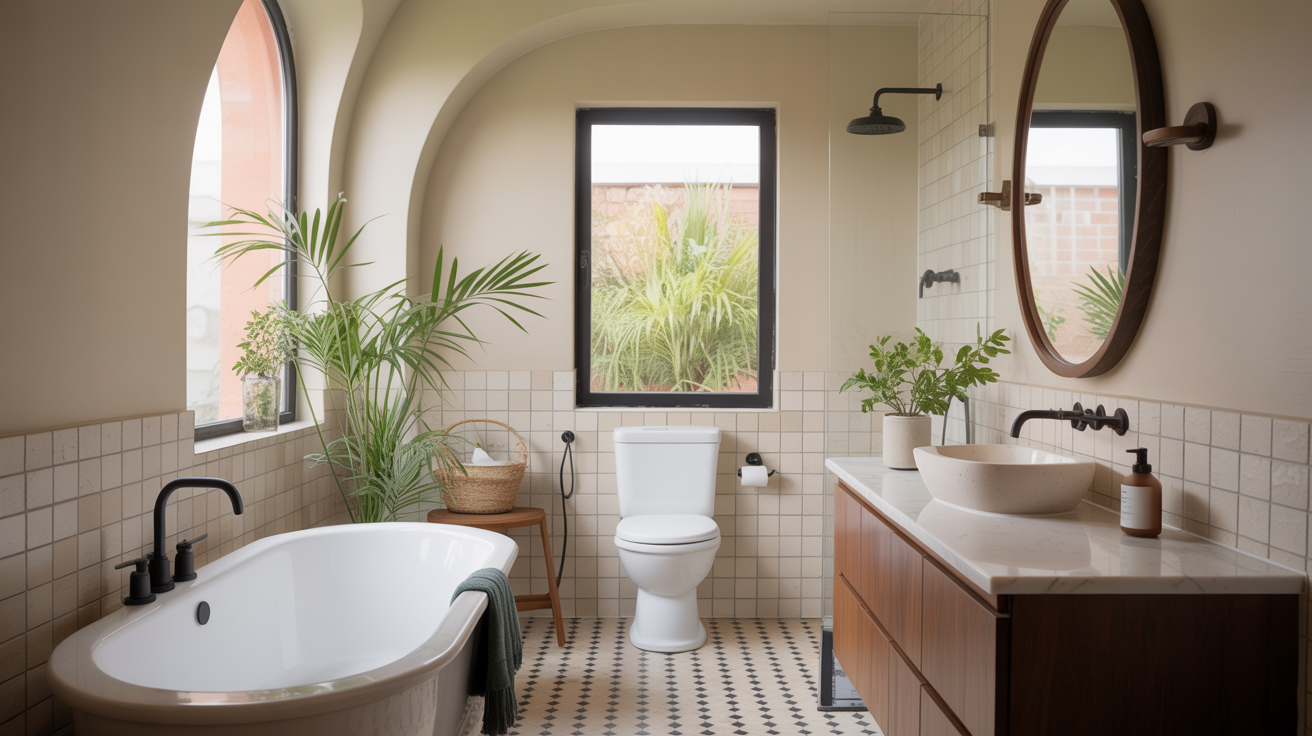
The best small bathroom layout is the one that fits your specific floor plan while meeting IRC clearance minimums. Most bathrooms under 60 square feet fall into four basic footprints, 5×7, 5×8, 6×6, and narrow single-wall, and each one has a layout that works better than the alternatives.
At a Glance
- Four footprints cover most small bathrooms: 5×7, 5×8, 6×6, and narrow single-wall under 4 feet.
- IRC minimums are a floor, not a target: 21 in. clearance in front of fixtures, 15 in. from a fixture centerline to a side wall, 30 in. center-to-center between fixtures.
- A pocket door can reclaim 6–8 sq ft of swing space, often the difference between a workable and unworkable small layout.
- Plumbing stays cheapest when fixtures share one wall; moving the drain stack is the single biggest cost driver in a layout change.
- If anyone using the bathroom has mobility needs, a 30 x 48 in. clear floor space and a 60 in. turning circle (ADA guidance) are worth planning for even in a non-commercial home.
- Always confirm clearances with your local building department, some jurisdictions require more than the IRC floor.
How clearances dictate your small bathroom floor plan
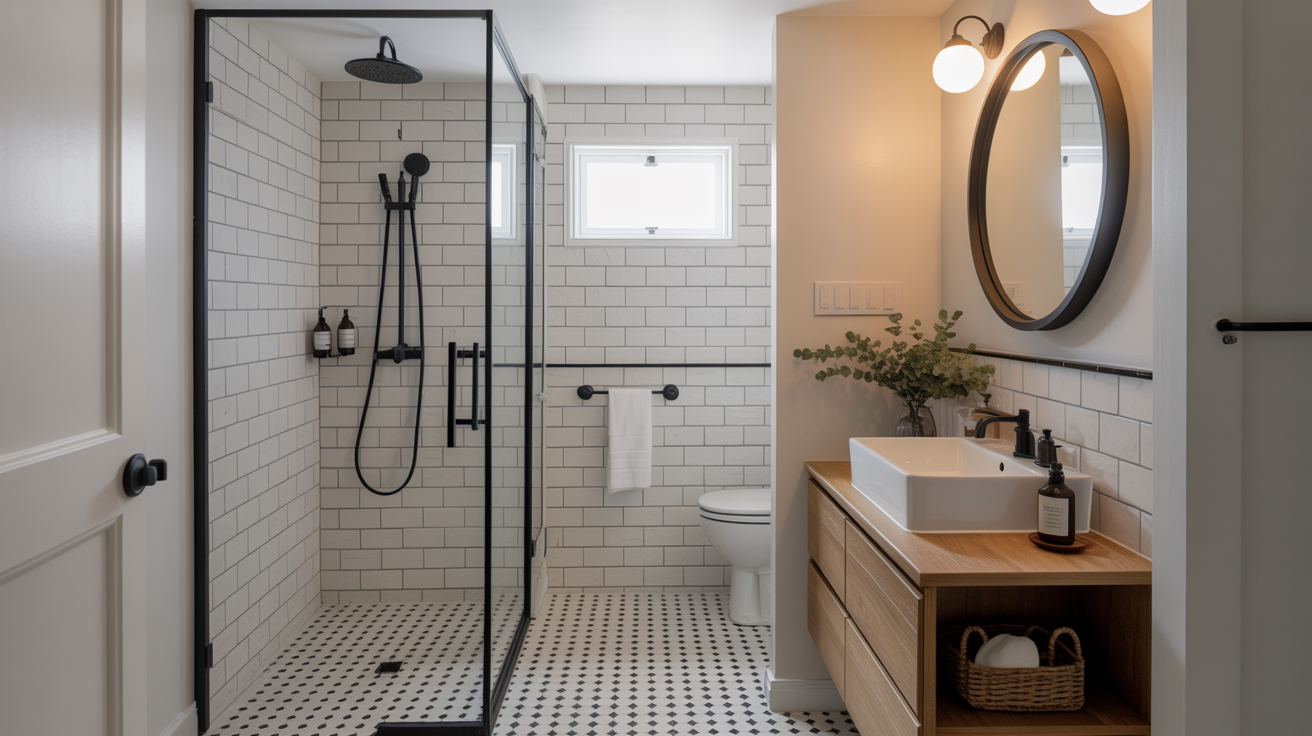
Before you move a single fixture on paper, you need to know what the International Residential Code requires. Local jurisdictions may be stricter, so treat these as a floor, not a ceiling.
| Clearance | IRC minimum |
|---|---|
| In front of toilet (to wall or fixture) | 21 in. |
| Toilet centerline to side wall or obstruction | 15 in. |
| Toilet centerline to next fixture centerline | 30 in. |
| In front of lavatory (knee clearance) | 21 in. |
| Shower minimum interior dimension | 30 in. × 30 in. |
| Shower door swing clearance | Varies by door type, see below |
These figures match Section P2705 and P2708 of the plumbing chapter in the International Residential Code, the model code most U.S. jurisdictions adopt with local amendments. Your building department's version may add stricter local requirements, so confirm before finalizing rough-in locations.
A pocket door or a barn-style bypass door can reclaim 6–8 square feet of swing space in tight rooms. Hinged doors typically need a 28–32 in. arc. If you're working under 40 square feet, that arc can eat the room.
Always verify clearances with your local building department before framing rough-in locations. Plumbing rough-ins are expensive to move after concrete or subfloor work is done.
Clearances for accessible layouts
If anyone using the bathroom, now or in the foreseeable future, has mobility limitations, the standard IRC minimums won't be enough room to maneuver a wheelchair or walker. The U.S. Access Board's ADA guidance calls for an unobstructed clear floor space of at least 30 by 48 inches beyond any door swing, plus a 60-inch turning circle (or an equivalent T-shaped space) somewhere in the room. Those figures are written for public and commercial bathrooms, but they're a useful planning target for a primary bath in a home you intend to age in place in. Retrofitting that clearance later, after tile and cabinetry are set, costs far more than building it in during a remodel.
5×7 bathroom layout (35 sq ft)
This is the most common full bathroom size in older American homes, tight, but workable. The standard arrangement stacks everything along one wall or two adjacent walls.
Single-wall layout (one plumbing wall)
All three fixtures line up on the 7-foot wall: toilet at one end, lavatory in the center, tub/shower at the other end. This keeps plumbing on one stack, which reduces cost. The toilet centerline needs to sit at least 15 inches from both the lavatory and the side wall, so the lavatory center typically lands around 42–48 inches from the toilet side wall.
The weakness of this layout is that the door has nowhere to go except the 5-foot wall opposite the fixtures. A 28-inch door works; a standard 30-inch door is tight. Consider a 24-inch pocket door on the short wall, which also gives you a stretch of open floor near the entry.
Two-wall layout
Toilet and lavatory on the 7-foot wall, tub/shower on the 5-foot end wall. This is the better choice when the existing rough-in already has the tub drain in the corner. The tub end wall placement also makes ventilation simpler, the exhaust fan can go directly above or behind the tub without a long duct run.
Door placement: the 5-foot wall opposite the tub end, as far from the tub as possible. A 28-inch outswing or a pocket door both work here.
5×8 bathroom layout (40 sq ft)
Five extra square feet changes things more than it sounds. A 5×8 bathroom is the sweet spot for a full three-fixture bath with some breathing room, and it's the default size in most post-WWII tract homes.
Standard 5×8 arrangement
Tub along the 8-foot wall, toilet and vanity on the opposite 8-foot wall, door on one 5-foot end wall. This is the layout you've seen in nearly every 1950s–1980s ranch house, and it works. The toilet centerline typically sits 18–20 inches from the wall, and with 60 inches of width, a 24-inch vanity leaves 16 inches to the toilet, which is within code (15-inch minimum to the centerline means the edge of the lavatory cabinet can't push past 3 inches from the toilet center).
One common 5×8 bathroom upgrade: swap the tub for a 36×36 or 36×48 walk-in shower and use the saved wall depth to add a larger vanity or a small linen cabinet. A 36-inch shower on a 5-foot wall leaves 24 inches for storage or a second door position.
Offset 5×8 layout
If the entry door is on the long wall rather than the short end, the layout rotates 90 degrees. Toilet goes in the far corner, lavatory next to it, shower on the short end wall. This works when the plumbing chase runs under the floor along the 5-foot dimension. It's less common but sometimes forced by where the drain stack sits in the floor.
For ideas on maximizing what you do with your square footage, see small bathroom ideas to make it feel bigger.
6×6 bathroom layout (36 sq ft)
Square bathrooms are awkward because no wall is long enough to comfortably line up all three fixtures in a row. The workable solutions involve corners.
Corner toilet, offset lavatory
Place the toilet in one corner with its centerline 15 inches from each side wall. That puts it 15 inches from the left wall and 15 inches from the back wall, which is the minimum. The lavatory goes on the adjacent wall, at least 30 inches from the toilet centerline. A 24-inch vanity fits with clearance to spare.
The shower then takes the remaining two walls as a corner unit. A 36×36 corner shower fits a 6×6 room, but 36×36 is the absolute minimum interior dimension, anything smaller violates IRC and feels genuinely claustrophobic. A curved corner shower door saves a few inches of swing space versus a square bypass door.
Wet-room approach
For a 6×6 bath that's purely a shower/toilet room (no tub, often used as a secondary bath), a wet-room configuration with a linear drain and a glass panel instead of a full enclosure can open the space considerably. The entire floor slopes to the drain; the toilet and vanity sit outside the shower zone but the open plan reads as larger. This requires a waterproofed subfloor and a licensed plumber who's done wet-room work before, not a weekend DIY job.
For storage solutions that don't eat floor space in a square room, small bathroom storage ideas that save space covers recessed niches, over-toilet shelving, and cabinet options that work even when the walls aren't thick enough for a full recess.
Narrow bathroom layout
"Narrow" typically means one dimension is 4 feet or less, a common footprint in row houses, older colonials, and converted closet-adjacent spaces.
A 4×8 or 4×9 bathroom forces a single-file layout: everything runs down one long wall, or fixtures face each other across the narrow dimension. The math is tight. With a 4-foot (48-inch) width:
- Toilet centerline at 15 inches from one wall leaves 33 inches to the opposite wall, enough for a wall-hung lavatory or a pedestal sink, but no base cabinet.
- A 30×30 shower at the far end is code-legal but uncomfortable for anyone over about 5'6". A 30×36 is a better minimum if you have the length.
A wall-hung toilet can save 4–6 inches of depth versus a floor-mounted model, which matters in a 4-foot-wide room. The in-wall tank carrier must be installed during rough framing.
Door options in a narrow bathroom: the door almost always has to be on the short end wall. A pocket door is strongly preferred because even a 24-inch outswing takes up 40% of a 4-foot width as it opens.
If your narrow bath is a half-bath, the options open up. See tiny half-bath ideas for awkward spaces for approaches specific to powder rooms under 20 square feet.
Choosing between a tub and a shower in a small bathroom floor plan
In a full bath under 50 square feet, this is the decision that shapes everything else. A standard alcove tub is 60×30 inches and runs along one wall. A 36×36 shower takes 9 square feet of floor instead of 12.5, but the tub's footprint is more shape-efficient because it fits flush against three walls.
If the bathroom is the only full bath in a home you plan to sell, keep the tub, buyers with children and appraisers both notice when it's gone. If the bathroom is a primary bath in a home with at least one other full bath, a walk-in shower is worth considering, especially for anyone with mobility constraints, see the accessible clearance note above for how much floor space that decision actually needs.
Prefab shower pans in 32×32, 36×36, 36×48, and 60×32 give you a range of options. Custom-tiled showers can be any dimension but cost significantly more and require a waterproofing system, Schluter Kerdi or a similar membrane, not just cement board.
Worked Example: Fitting a 5×7 for Two Users
Here's how the numbers actually stack up on paper for a real 5×7 (60 x 84 in.) two-wall layout, the kind of math worth doing before you call a contractor.
| Element | Placement | Dimension | Clearance check |
|---|---|---|---|
| Toilet | Corner of 7-ft wall | Centerline 15 in. from side wall | Meets 15 in. minimum exactly |
| Lavatory | 7-ft wall, next to toilet | 24 in. wide vanity | Centerline 32 in. from toilet, clears 30 in. minimum |
| Tub/shower | 5-ft end wall | 60 x 30 in. alcove tub | Full wall width used, no clearance issue |
| Door | 5-ft wall opposite tub | 28 in. pocket door | Swing eliminated, floor stays open |
| Open floor | Center of room | Roughly 30 x 40 in. | Under ADA's 30 x 48 in. target, would need a 6-in. wider room to hit it |
That last row is the honest takeaway: a stock 5×7 clears code but falls short of ADA's accessible clearance by about 6 to 8 inches in one direction. If accessibility matters for this bathroom, a 5×8 or larger footprint makes the difference achievable without a wet-room retrofit.
Frequently Asked Questions
What is the minimum size for a bathroom with a toilet, sink, and shower?
IRC requires at minimum a 30×30 inch shower interior, 21 inches of clear floor space in front of the toilet and sink, and 15 inches from the toilet centerline to any side obstruction. In practice, a room smaller than 4×6 feet can't meet all three simultaneously. Most building departments want at least 5×7 for a full bath. Check with your local jurisdiction, some require more.
Can I put a pocket door on any small bathroom?
Mechanically, yes, as long as the wall is not load-bearing and doesn't contain plumbing or electrical runs that can't be relocated. Pocket doors need a wall cavity at least as wide as the door (typically 28–32 inches), which can conflict with adjacent framing or fixtures. A licensed contractor can assess whether the wall framing works.
How do I know where my existing plumbing rough-ins are?
The toilet flange center is visible on the floor. Measure from the finished wall behind it, that's the rough-in distance, usually 10, 12, or 14 inches. The lavatory drain and supply lines are typically in the wall behind the vanity. Moving a toilet more than 6–8 inches from its existing flange usually means cutting the subfloor or slab, which is a significant cost.
Is a 5×8 bathroom big enough for two people to use simultaneously?
That depends entirely on the layout. A 5×8 with a pocket door and a separate toilet alcove (even a partial wall or frosted glass partition) gives reasonable privacy. The standard open-plan 5×8, tub on one wall, toilet and sink across from it, does not offer meaningful separation. If you're remodeling a shared bath, a partial privacy wall between the toilet and the rest of the room is worth the 6–8 inches it costs.
What's the cheapest change that makes a small bathroom feel less cramped?
Replacing the vanity mirror with a full-width mirror that runs from cabinet side to cabinet side, or floor-to-ceiling on one wall, creates an immediate sense of depth. It doesn't change the floor plan at all. After that, a clear glass shower enclosure instead of a frosted or patterned door opens up the visual space substantially. Neither requires moving any plumbing.
Do IRC clearances apply to a DIY remodel, or only to licensed contractors?
They apply either way. Building departments inspect the finished rough-in and framing regardless of who did the work, and an inspector who finds a toilet centerline at 13 inches from the wall will fail it whether a homeowner or a licensed plumber set it. The code exists to keep fixtures usable and code violations from complicating a future home sale, not to regulate who's allowed to swing a hammer.