Fixtures & Vanities
Bathroom Mirror Ideas and How to Size Them Right
Explore bathroom mirror ideas for every vanity style, plus exact sizing rules so your mirror looks proportional and hangs at the right height.
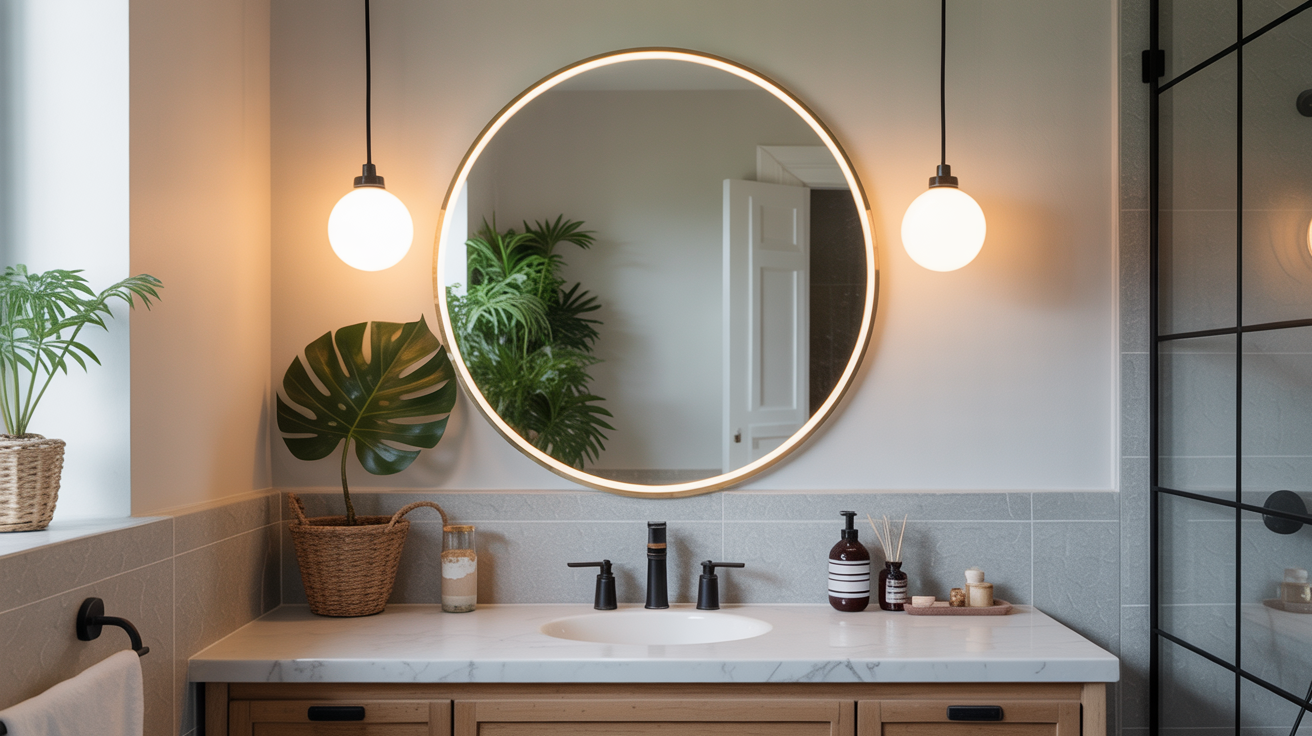
A bathroom mirror is one of those choices that seems simple until you are standing in the store holding a tape measure, unsure whether 36 inches is too small or 48 inches is overkill. The mirror affects lighting, proportion, and the overall feel of the room more than most fixtures do. Get the size wrong and even a beautifully tiled bathroom can look off. Get it right and the whole space clicks.
This guide covers common vanity mirror ideas, the specific numbers you need for sizing, and a few practical decisions worth thinking through before you buy.
At a Glance
- Keep the mirror 2 to 4 inches narrower than the vanity on each side; a 48-inch vanity typically wants a 40 to 44-inch mirror.
- Standard mounting puts the bottom edge 5 to 8 inches above the faucet handles and the top edge 65 to 72 inches from the floor.
- Federal accessibility standards for mirrors above a lavatory set the bottom edge no higher than 40 inches from the floor, worth knowing even outside a formal accessible bathroom, since it's a useful lower bound for a mirror that needs to work for shorter users or a seated wheelchair user.
- Frameless mirrors read larger than framed mirrors of the same size and can push closer to full vanity width without looking heavy.
- Any mirror over 24 inches in either dimension needs to be secured into studs or a backing board, not drywall anchors alone.
- Hardwired backlit mirrors need an electrician and a permit; plug-in models only need a nearby outlet.
The Sizing Rules That Actually Matter
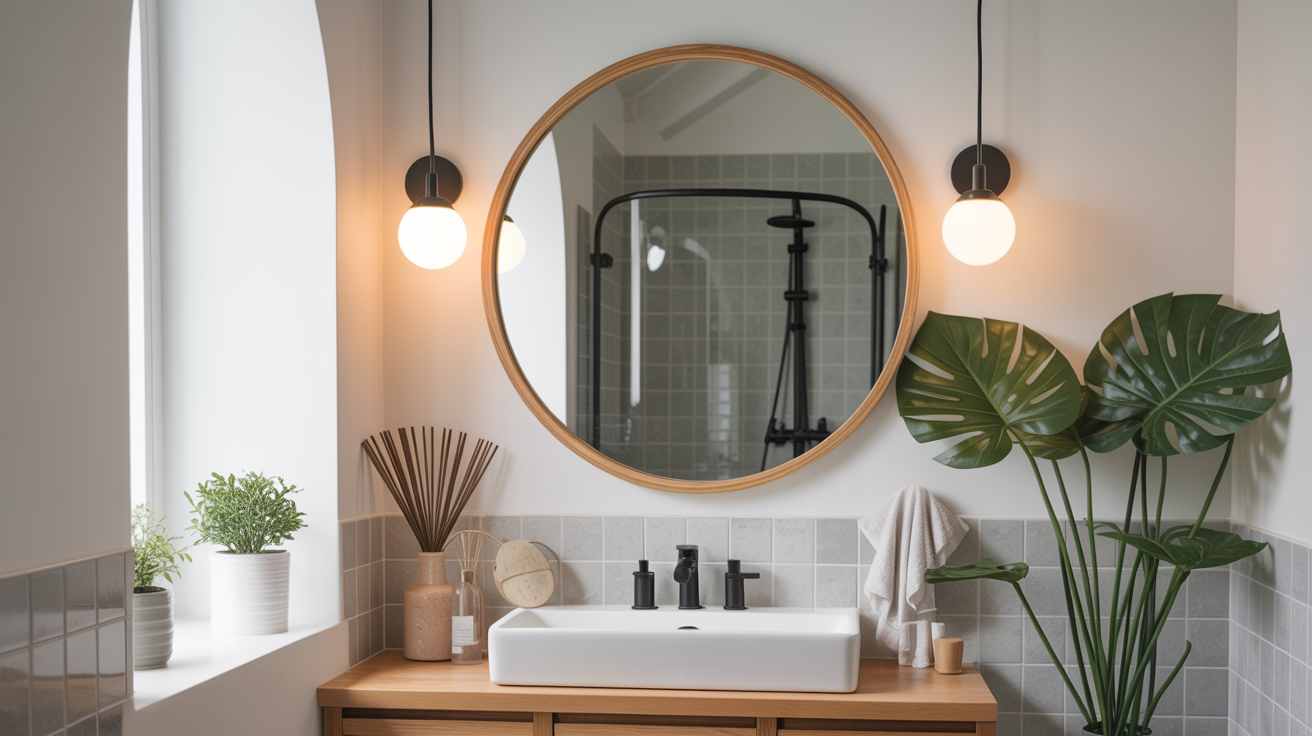
Most sizing guidance for bathroom mirrors boils down to two dimensions: width and height. Both have sensible defaults, and both can be adjusted based on your specific layout.
Width in Relation to the Vanity
The standard advice is to keep the mirror 2 to 4 inches narrower than the vanity on each side. So if your vanity is 48 inches wide, a mirror somewhere between 40 and 44 inches wide sits proportionally without crowding the wall or extending past the cabinet edges.
That said, the rule has flexibility. A frameless mirror can often run closer to the full vanity width without looking heavy, because there is no visual border adding to the mass. A thick wood or metal frame pushes the perceived size outward, so you may want to stay closer to the 4-inch-per-side reduction.
For double vanities (typically 60 to 72 inches wide), you have two options: one wide mirror spanning the full vanity, or two separate mirrors centered over each sink. The single-mirror approach feels cleaner and more contemporary. Two mirrors work well when you want distinct task zones or when you are hanging sconces between them. There is no wrong answer, but the two-mirror approach does require more precise placement to avoid a cluttered look. If you are still deciding on the vanity configuration itself, the guide on single vs. double vanity options walks through the trade-offs in more detail.
Height and Mounting Position
Standard mounting height places the bottom edge of the mirror 5 to 8 inches above the faucet handles, or roughly at countertop backsplash height. The top edge should sit at or slightly above eye level for the tallest person who uses the bathroom regularly. A common target is 65 to 72 inches from the floor to the top of the mirror.
Taller mirrors (those reaching 36 inches or more in height) are useful if the bathroom has high ceilings or if you want the glass to reflect light across a wider vertical area. Shorter mirrors (around 24 inches) work in powder rooms or in bathrooms where sconces are mounted on the mirror frame itself, since you do not need as much vertical glass coverage.
For a bathroom that needs to work for a wider range of users, whether that's a household with kids, a short adult, or a member of the household using a wheelchair, it's worth knowing the federal accessibility benchmark even if you're not building to a formal accessible-bathroom spec. The U.S. Access Board's ADA guidance sets the maximum mirror height at 40 inches to the bottom of the reflecting surface when the mirror is mounted above a lavatory or countertop, which is noticeably lower than the 5-to-8-inches-above-the-faucet default most residential mirrors use. A taller mirror that starts closer to that 40-inch line, rather than right at the backsplash, works for a broader range of heights without looking out of proportion.
One practical note: if you have a medicine cabinet, you are already locked into its dimensions. Many homeowners treat a recessed medicine cabinet as a mirror and add a separate decorative mirror elsewhere or skip the additional mirror entirely. Mirrored medicine cabinets come in standard widths of 14, 16, 20, 24, and 30 inches, so check what rough-in exists in your wall before committing to a surface-mount or recessed unit.
Mirror Sizing Reference
Use this as a starting point, then adjust for frame thickness and how the mirror needs to work with sconces or a backlit design.
| Vanity Width | Suggested Mirror Width | Typical Mirror Height | Notes |
|---|---|---|---|
| 24 to 30 in (powder room) | 20 to 26 in | 24 to 30 in | Shorter mirror often paired with an overhead bar light |
| 36 in | 30 to 34 in | 30 to 36 in | Common single-sink vanity size |
| 48 in | 40 to 44 in | 34 to 40 in | Frameless can run up to 46 in |
| 60 in (double vanity, one mirror) | 52 to 56 in | 36 to 42 in | Leaves clean margins at each outer edge |
| 60 to 72 in (double vanity, two mirrors) | 24 to 30 in each | 34 to 40 in each | Center each mirror over its sink, not the full vanity |
Mirror Styles and What Each One Is Good For
Bathroom mirrors fall into a few broad categories. Knowing what each does well makes the choice more straightforward.
Framed Mirrors
A framed mirror has a visible border, typically wood, metal, or composite. Frames add warmth and visual weight, which suits transitional and traditional bathrooms well. A dark walnut frame over white subway tile reads as grounded and finished. A brushed brass frame can tie into hardware finishes without being loud about it.
The trade-off is that frames accumulate moisture and dust in bathroom environments. Solid wood frames need to be sealed properly, and some budget composite frames can warp near a steam-heavy shower. Look for frames rated for humid environments or opt for metal when durability is a priority.
Frameless Mirrors
Frameless mirrors are exactly what they sound like: polished or beveled glass with no surrounding border. They suit modern and minimalist bathrooms and tend to read as larger than framed mirrors of the same dimension because the glass goes edge-to-edge.
They are also easier to keep clean since there is no frame ledge to collect residue. The downside is that without a frame, the mirror relies entirely on clean proportions to look intentional. A frameless mirror that is even slightly the wrong size for the vanity below it looks like an afterthought rather than a design choice.
Nearly all modern mirrors, framed or frameless, start as float glass with a thin reflective layer applied to the back. Manufacturers typically build that layer by depositing silver directly onto the glass through a wet chemical process, sometimes substituting nickel or chromium, then sealing it with a protective coating. A better protective backing is part of why some mirrors hold their reflective quality for decades in a humid bathroom while a cheaper one develops black edge spots (often called "black mirror disease") within a few years, since the coating is what keeps moisture from reaching the silvering.
Backlit and LED Mirrors
A backlit bathroom mirror has LEDs embedded around the perimeter (or across the full back panel), casting a soft glow behind the glass. LED mirrors have become common enough that the price range is wide, from basic plug-in units to hardwired fixtures with dimmer controls and anti-fog pads.
The light from a backlit mirror is not a replacement for proper overhead or side lighting, but it does reduce harsh shadows on the face, which makes it more useful for grooming than a bright ceiling fixture alone. If you are rewiring the bathroom anyway, hardwiring an LED mirror into a dedicated switch circuit makes sense. For a simpler update, plug-in LED mirrors work well provided there is an outlet nearby.
One consideration: LED strips inside the mirror have a lifespan measured in tens of thousands of hours under normal use. The Department of Energy rates good-quality white LED products at 30,000 to 50,000 hours or longer of useful life, which at a couple of hours a day of bathroom use works out to decades. In practice, the driver components (the electronics that regulate power to the LEDs, not the LEDs themselves) tend to fail well before that ceiling. Look for units with replaceable drivers or at least a solid warranty (three years or more is reasonable to expect).
How to Think About the Mirror Alongside Other Fixtures
The mirror does not exist in isolation. Its finish, frame material, and proportions interact with the faucet, the vanity hardware, and any light fixtures above or beside it.
A brushed nickel faucet pairs comfortably with a silver or chrome mirror frame. Matte black hardware looks sharp against a frameless mirror or a mirror with a thin black metal frame. Mixing metals is acceptable (and often looks less sterile than a perfectly matched set), but the mirror is one of the larger objects on the wall, so its finish tends to anchor the room's palette.
If you have not yet chosen your faucet, the guide on bathroom faucet types covers how finishes and spout styles interact with the overall vanity setup, which is worth reading before finalizing the mirror frame finish.
Light fixtures are the other variable. Side-mounted sconces (positioned 60 to 65 inches from the floor, flanking the mirror) provide more even light than an overhead bar. If you are going with sconces, size the mirror so there is 18 to 24 inches of clear wall on each side for the fixture. Overhead light bars work fine in smaller bathrooms or powder rooms where wall space is tight.
Before You Buy: A Short Checklist
A few things to verify before ordering or carrying anything home:
- Measure the rough opening above the vanity, not just the vanity width. Note any outlets, switches, or plumbing access panels that the mirror might need to clear.
- Check the wall construction. Drywall anchors alone are not adequate for mirrors heavier than 10 to 15 pounds. A mirror over 24 inches in either dimension should be secured into studs or a backing board.
- Confirm the mounting hardware. Most mirrors ship with a French cleat, J-bar, or direct-mount clips. Know which you have and whether you need additional hardware for your wall type.
- Account for the faucet clearance. The bottom edge of the mirror should clear the faucet spout when it is fully open. Usually 5 to 8 inches above the counter is enough, but vessel sinks or tall widespread faucets may require more clearance.
- Weigh the mirror before hanging it, not after. Large-format mirrors, especially thick frameless glass over 36 inches, can run 40 to 60 pounds or more. That's well past what any drywall anchor is rated for and puts you firmly in stud-mount or backing-board territory.
If you are also in the process of choosing the vanity itself, the article on how to choose a bathroom vanity covers depth, height, and storage trade-offs that affect how the mirror will relate to the finished setup.
Frequently Asked Questions
How big should a bathroom mirror be above a 48-inch vanity?
A 40 to 44-inch wide mirror is the common range. That keeps the mirror 2 to 4 inches narrower than the vanity on each side, which reads as proportional. If you are using a frameless mirror, you can push closer to 46 inches without it looking oversized.
How high should I mount a bathroom mirror?
The bottom edge typically sits 5 to 8 inches above the backsplash or faucet handles. The top edge should reach 65 to 72 inches from the floor, which puts it near or slightly above eye level for most adults. Adjust upward if the primary users are particularly tall, and consider dropping the bottom edge closer to 40 inches from the floor if the mirror needs to work well for a shorter user or someone seated.
Are backlit mirrors worth the extra cost?
For a bathroom you use daily, yes. The ambient lighting reduces harsh face shadows in a way that a ceiling fixture alone cannot match, and anti-fog functionality (available on many LED units) is genuinely useful in a steam-heavy bathroom. The main caveat is that driver electronics can fail before the LEDs do, so buy from a brand with a reliable warranty.
Can I use one large mirror over a double vanity instead of two separate mirrors?
Yes, and many designers prefer it. A single wide mirror (sized to the full vanity width minus 2 to 4 inches per side) looks cleaner and reflects more light than two smaller mirrors with a gap between them. Two mirrors make more sense when you want sconces mounted between them or when the two sink zones are used at the same time by people with very different heights.
Do I need an electrician to install a backlit mirror?
If the mirror is hardwired, yes. Running a new circuit or adding a junction box behind the mirror is electrical work that requires a permit in most jurisdictions. Plug-in LED mirrors do not require an electrician, but they do need an outlet within reach, and a cord hanging from a bathroom mirror is not ideal. Plan the rough-in during any bathroom remodel so you have a dedicated circuit ready.
Why does my mirror have dark spots or a cloudy edge after a few years?
That's typically moisture reaching the reflective backing through a gap in the edge seal, sometimes called black mirror disease or desilvering. It starts at the edges and spreads inward, and it isn't repairable, the mirror needs to be replaced. Bathrooms with poor ventilation and mirrors mounted directly above a shower or tub see this fastest. A well-sealed mirror with a quality edge coating, kept in a bathroom with working exhaust ventilation, should last well beyond a decade before this becomes a concern.
Should the mirror match the vanity's finish exactly?
No, and matching too precisely can actually flatten the room. A mirror frame or an LED mirror's trim in the same general finish family as the faucet and hardware (all warm metals, or all cool metals) reads as coordinated without needing to be identical. A little contrast, like a black-framed mirror with brushed brass hardware, often looks more considered than a perfectly matched set.