Fixtures & Vanities
Single vs Double Vanity: Which One Fits Your Bathroom
Single or double vanity? This guide covers dimensions, cost, plumbing rough-in, and resale value so you can choose the right vanity for your bathroom.
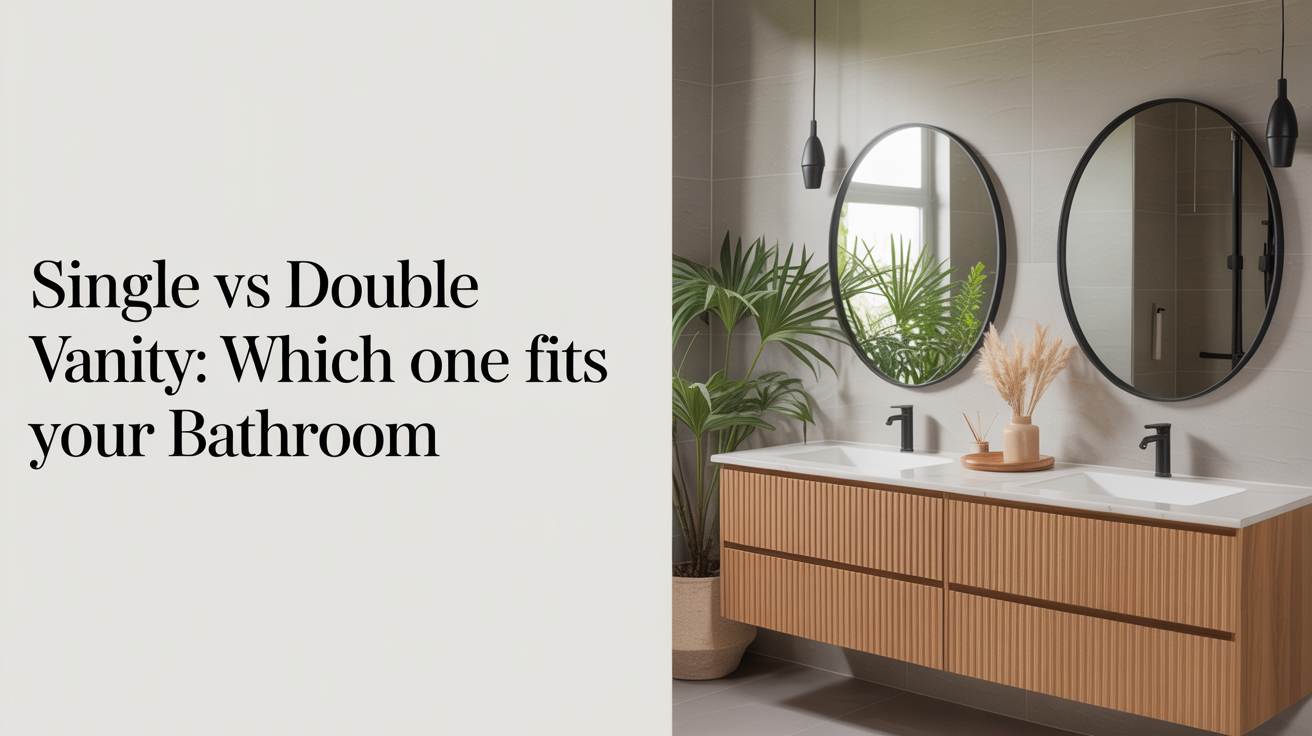
The honest answer: a double vanity is only better than a single if your bathroom has the floor space and plumbing to support it. Get the fit wrong and you end up with a vanity that crowds the toilet, blocks the door swing, or sits over a drain you can't practically move.
Here's how to make the right call before you order anything.
How Much Space Do You Actually Need?
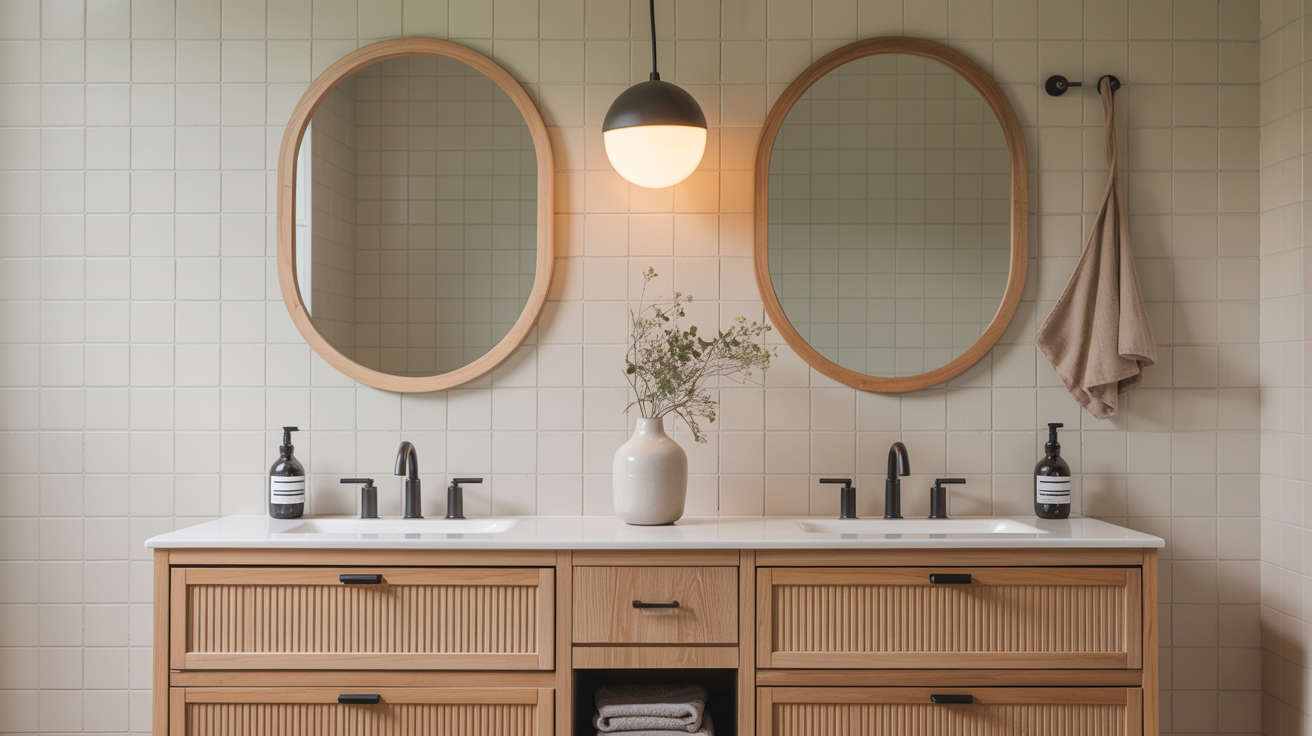
Width is the hard constraint. A single vanity runs 24–48 in. wide; a double vanity typically starts at 60 in. and can stretch to 72 in. or beyond. Those numbers aren't arbitrary, they account for two sinks, the dead counter space between them, and room to open cabinet doors without bumping elbows.
The 60 in. minimum for a double is a real floor-space commitment. Measure from the inside of each wall (or from the wall to the centerline of your toilet, whichever comes first). The National Kitchen and Bath Association recommends at least 18 inches of clearance from the toilet centerline to a side wall or neighboring fixture; 15 in. is a bare code minimum in most jurisdictions. Compress that clearance to shoehorn in a wider vanity and the bathroom will feel cramped every single day.
If your bathroom runs 60 in. or wider wall-to-wall and the toilet position isn't a constraint, a double vanity is physically feasible. If your bathroom is 5 ft. wide with a toilet on one side, you almost certainly need a single.
Door and Walkway Clearance
An often-overlooked detail: the bathroom door. A standard interior door swings a 30–36 in. arc. If you widen the vanity and the door now sweeps over it, or can't fully open, that's a problem you'll notice forever. Check your door swing on the floor plan before you finalize any width.
Single vs Double Vanity: A Direct Comparison
| Factor | Single Vanity | Double Vanity |
|---|---|---|
| Minimum width to consider | 24 in. | 60 in. |
| Counter space per sink | Moderate to generous (depends on width) | Often less per person than a wide single |
| Under-sink storage | One cabinet run | Two separate cabinets, slightly more total |
| Plumbing rough-in | One drain, one supply pair | Two drains, two supply pairs |
| Typical cost (vanity only) | $300–$1,200+ | $800–$3,000+ |
| Installation complexity | Straightforward | Higher, second drain line may need new rough-in |
| Resale appeal | Neutral to positive | Strong positive in master baths |
Cost ranges above are for the vanity cabinet and sink(s) only, not faucets, installation labor, or any plumbing modifications. See the faucet guide for what to budget per faucet.
Do You Actually Need Two Sinks?
This is the real question, and the honest answer depends on how many people share the bathroom and when they use it.
Two sinks make genuine sense in a master bath shared by two adults who get ready at the same time. If you and your partner are reliably both at the sink between 7:00 and 7:30 a.m., a double vanity will reduce real friction in your morning.
In a guest bathroom, a hallway bath used by kids, or a master bath where one person travels most of the week, a second sink mostly means a second drain to unclog and a second faucet to replace in ten years. The extra counter space from a wide single vanity (say, a 48 in. or 60 in. single with one centered sink) is often more practical than splitting that same width into two sink basins.
One more thing to think about: storage. Two under-sink cabinets sound like more storage, but each cabinet has a plumbing stack running through it. A wide single vanity with one cabinet run and full-width drawers often beats a double on usable storage per square foot of vanity width.
Plumbing Rough-In: The Cost People Miss
If your existing bathroom has one drain and one set of supply lines, adding a second sink isn't just a vanity swap, it's a plumbing job. A plumber needs to run a second drain (tied into the existing stack or branch line), add shutoff valves, and extend supply lines to the new sink location. Depending on wall construction and drain configuration, that work can run $500–$1,500 or more in labor alone.
If your current rough-in already has two drains spaced for a double vanity, common in newer construction or in bathrooms that previously had a double, the swap is much more straightforward.
Before you commit to a double vanity in a bathroom that currently has a single, have a licensed plumber look at your rough-in. Get the scope and a real number before you order the vanity. This is one of those cases where the unit cost of the fixture is only part of the total project cost.
For a deeper look at how to match a vanity to your bathroom layout and existing rough-in, the bathroom vanity sizing guide walks through measuring for both freestanding and built-in styles.
Double Vanity Dimensions: Standard Sizes and What They Mean
If you've decided a double vanity fits your space, here's how to read the specs:
Width: Most double vanities are 60 in., 66 in., or 72 in. A 60 in. double is the most common; it typically fits two 18–20 in. sinks with modest counter space between them. At 72 in. you get more breathing room per sink and more counter space, but you're committing to 6 ft. of linear wall space.
Depth: Standard vanity depth is 21–22 in. Some shallow-depth models run 18 in., which is useful in tight rooms but limits bowl size. Confirm that a shallow vanity still clears your plumbing rough-in before ordering.
Height: Standard is 32–36 in. "Comfort height" (34–36 in.) suits taller users and is now the default in most new construction. If you're replacing a 32 in. vanity with a 36 in. model, check that your mirror and lighting aren't awkwardly low.
Sink spacing: On a 60 in. double vanity, the two sink centerlines are typically 30 in. apart, matching NKBA's recommended minimum for lavatory spacing. That's workable but not spacious. On a 72 in. model the spacing opens up to roughly 36 in., which feels considerably less crowded.
Resale Value: What Buyers Actually Notice
Real estate agents consistently point to master bathroom upgrades as high-return projects, and a double vanity in a master bath is one of the specific features buyers look for. Two sinks signal that a master bathroom was designed for two adults, that's a meaningful feature when buyers are evaluating competing listings.
In a guest bath or secondary bathroom, the resale calculus is different. Buyers in those spaces mostly want the room to feel clean, functional, and appropriately sized. A well-chosen single vanity in a secondary bath won't hurt resale; a cramped double vanity that blocks the toilet might.
If resale is part of your thinking and you're renovating a master bath with enough square footage, a double vanity is probably worth the investment. For every other bathroom in the house, focus on fit and function over the number of sinks.
A bathroom remodel that includes a new vanity often pairs with shower updates. The walk-in shower guide covers how to allocate floor space when you're redesigning the whole wet zone.
Frequently Asked Questions
What is the minimum bathroom size for a double vanity?
There's no single minimum room size, because it depends on layout, but as a working rule, a bathroom needs to be at least 8–9 ft. wide to fit a 60 in. double vanity and still maintain comfortable clearance around the toilet and door swing. In a narrower room, a wide single vanity usually serves the space better.
Can I replace a single vanity with a double without moving plumbing?
Sometimes. If the second drain location works out to be near an existing branch line and your walls are open (during a renovation), the cost can be reasonable. But in a finished bathroom with a single rough-in, adding a second drain almost always means opening the wall. Get a plumber's assessment before you commit, the answer depends heavily on your specific layout.
How far apart should double vanity sinks be?
A comfortable minimum is about 30 in. between sink centerlines. Below that, two people using the sinks simultaneously will bump elbows. On a 72 in. vanity, centerlines at 36 in. apart gives each person more personal space. Check the manufacturer's spec sheet, not just the vanity width, the actual sink placement varies between models.
Is a double vanity worth it in a small master bathroom?
Usually not. If fitting a 60 in. vanity requires compromising toilet clearance or door swing, the daily inconvenience outweighs the convenience of two sinks. A 48 in. single vanity with good storage often performs better in a space-constrained master bath.
Do both sinks in a double vanity need separate faucets?
Yes, each sink basin gets its own faucet. That means two faucets to purchase, install, and maintain. Factor that cost in when comparing a single vanity to a double; on a mid-range project, two faucets can add $300–$800 to the total.
The Tiled Bath is an independent home-improvement resource. Our guides are researched and written in-house; we are not affiliated with, endorsed by, or sponsored by any brand, manufacturer, or retailer we mention. For plumbing rough-in changes or structural modifications, always consult a licensed professional and check your local building codes.