Tile & Flooring
Subway Tile Patterns and Layout Ideas
Explore every subway tile pattern from classic running bond to herringbone — with grout tips, waste estimates, and layout advice for any bathroom.
Subway tile is one of the few materials that looks at home in a 1920s bungalow and a brand-new minimalist bathroom alike. The pattern you choose matters as much as the tile itself, the same 3x6 white ceramic can read as classic, modern, or graphic depending on how it's laid.
At a Glance
- Five core layouts cover almost every subway tile bathroom: running bond, 1/3 offset, stacked/grid, herringbone, and vertical stack.
- Waste percentage swings from 5-8% (stacked, simple cuts) to 15-25% (herringbone, all-diagonal cuts), so order accordingly before you're short mid-job.
- Stacked and vertical layouts demand a flat, plumb wall, snap layout lines with a laser level rather than trusting the corner.
- Grout color and joint width change how the pattern reads as much as the layout choice itself; test a sample against your actual tile, not the store display.
- For wet floors, check both the DCOF (wet coefficient of friction, 0.42 minimum per code) and the PEI wear rating before assuming a wall tile works underfoot.
- Start every layout from the center of the focal wall, never from a corner, corners are rarely square.
The Five Core Subway Tile Layouts
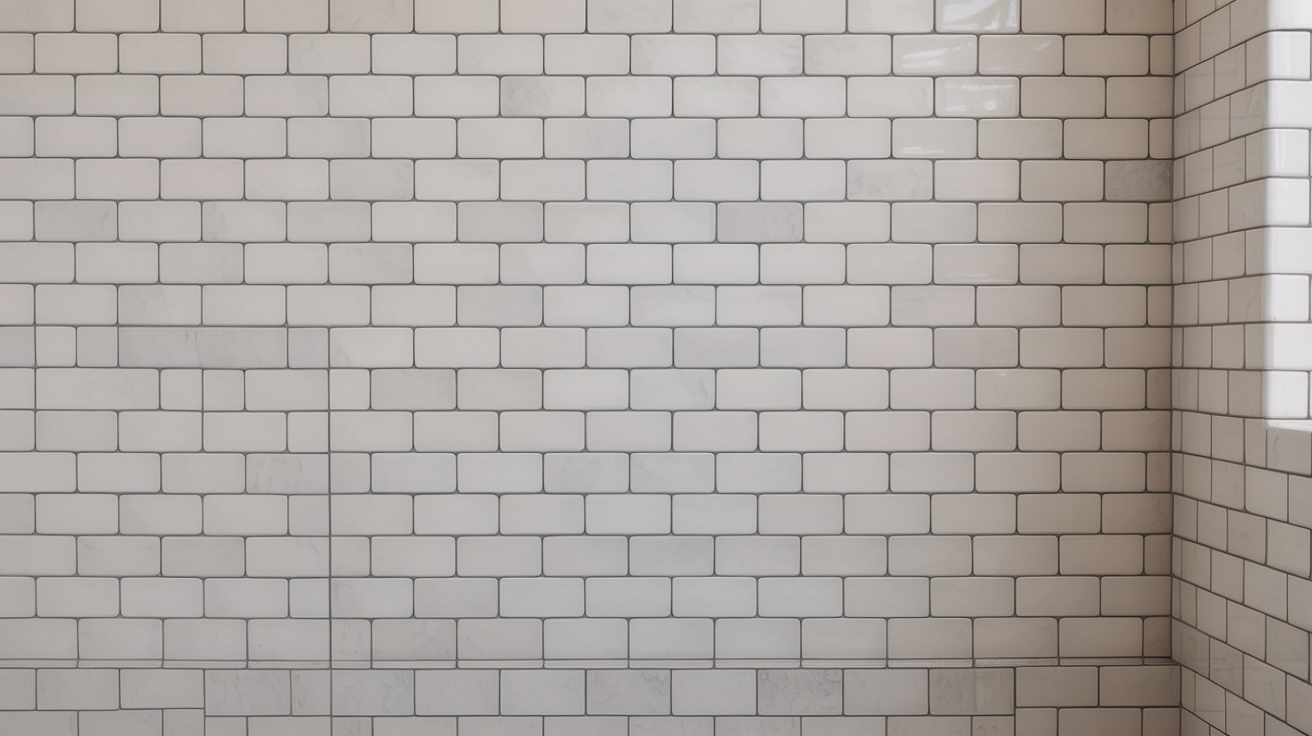
Most subway tile bathrooms use one of five patterns. Each changes how the tile reads on the wall, how much cutting is involved, and how forgiving the install is on walls that aren't perfectly plumb.
Running Bond (50% Offset)
This is the default. Each row is offset by half the tile length, so the vertical joints never line up. It's what most people picture when they say "subway tile." The pattern is familiar without being boring, and it hides minor lippage better than a stacked layout because your eye follows the horizontal lines.
Difficulty is low. It cuts in a predictable half-brick rhythm, and any tile setter has done it hundreds of times. If you're a confident DIYer tiling your first shower, start here.
1/3 Offset
Instead of shifting each row by half, you shift it by one-third of the tile length. The visual effect is subtler than running bond but feels fresher. Some people find it reads as more contemporary without being loud about it.
One practical reason to choose 1/3 offset: very long tiles (4x12 or 4x16 planks) can look awkward at 50% offset because the stagger becomes too obvious. A 1/3 shift tightens that up. Waste is similar to running bond, plan for 10%.
Stacked / Grid
Every joint lines up, horizontally and vertically, creating a clean grid. This is the most modern-looking subway tile pattern and pairs well with thick grout lines in a contrasting color. It also suits large-format subway styles (3x9, 4x12) that look architectural when stacked.
The catch: stacked patterns expose any wall imperfection immediately. A wall that's even slightly out of plumb will show it in the vertical grout lines. This pattern rewards good prep, backerboard flattened to within 1/8 inch across 10 feet, and layout lines snapped with a laser level.
Waste is the lowest of all the patterns, typically 5-8%, because most cuts are simple right-angle trims at the perimeter.
Herringbone
Herringbone subway tile is the pattern people want when they want something special. Tiles are set at 45-degree angles to each other, creating a zigzag that draws the eye across the surface. On a shower wall it adds movement; on a backsplash it becomes the focal point of the room.
The trade-off is installation complexity. Every tile along the perimeter needs a diagonal cut, which means more saw time and more waste. A standard herringbone layout generates 15-20% waste. Double-check your tile count before ordering.
There are two versions: standard herringbone (the classic 45-degree zigzag) and vertical herringbone (the same pattern rotated 90 degrees, so the chevrons point up and down rather than side to side). Vertical herringbone makes a low ceiling feel taller.
Vertical Stack
Take the stacked/grid layout and rotate it 90 degrees, so tiles run portrait rather than landscape. This is the layout you see in a lot of contemporary European bathrooms. It makes walls feel taller and works especially well in a subway tile bathroom with standard 8-foot ceilings.
Like horizontal stacked, it requires a very flat wall. Grout line alignment is unforgiving. Choose a tile with tight dimensional tolerances, rectified edges are worth the extra cost here.
Layout Comparison at a Glance
| Pattern | Look | Install Difficulty | Tile Waste | Best Use |
|---|---|---|---|---|
| Running Bond (50% offset) | Classic, timeless | Low | 10% | Any shower or bath wall |
| 1/3 Offset | Subtly modern | Low | 10% | Long-format tiles (4x12+) |
| Stacked / Grid | Clean, contemporary | Medium | 5-8% | Accent walls, flat plumb walls |
| Herringbone | Graphic, dynamic | High | 15-20% | Backsplashes, shower niches |
| Vertical Stack | Tall, architectural | Medium | 8-10% | Low-ceiling bathrooms |
A Worked Example: Ordering Tile for a Shower Wall
Say you're tiling a 40-square-foot shower enclosure (three walls, roughly 5x8 ft. total unfolded) in a standard 3x6 subway tile at running bond. At 10% waste, you'd order 44 square feet, rounded up to whatever box size the manufacturer sells, typically in increments that cover 8-10 sq. ft. each. Switch that same wall to herringbone at 18% waste and you need 47.2 square feet, nearly a full extra box, purely because of the diagonal perimeter cuts. On a $6-per-square-foot tile, that's roughly $19 in extra material for herringbone versus running bond on this wall, a small price for a very different look, but it's the kind of number that should be in your budget before the order goes in, not after the wall is half tiled and you're short a box with a different dye lot.
Choosing a Grout Color
Grout is not an afterthought. It's a design element that can reinforce the pattern or flatten it.
Matching grout (close to the tile color) lets the pattern speak quietly. White tile with warm white grout reads as one unified surface, understated, spa-like. This is the best choice when you want the pattern to recede and the fixtures to lead.
Contrasting grout (dark grout on white tile, or white grout on dark tile) draws every joint into focus. Running bond with charcoal grout looks graphic and confident. Herringbone subway tile with a dark grout makes the zigzag almost pop off the wall. The visual effect is strong, but so is the maintenance, dark grout on a shower floor can streak if it's not sealed regularly.
Warm vs. cool tones: Most white subway tile has a slight warmth to it (a cream or ivory cast). A stark bright-white grout against a warm-white tile can look mismatched under bathroom lighting. Order a grout sample and test it next to your actual tile before committing.
Width matters too. A wide grout joint (3/16 inch or more) emphasizes the pattern; a tight joint (1/16 inch) minimizes it. Stacked and vertical layouts generally look better with a slightly wider joint because tight joints require near-perfect tile tolerances that budget ceramics rarely deliver.
Before you finalize any tile and grout combination, it's worth reading through how to choose bathroom floor tile that lasts, the durability and porosity notes apply to wall tile just as much.
Planning Your Subway Tile Layout
The most common mistake in a subway tile bathroom is starting from a corner. Corners are almost never square, and walls are almost never plumb. If you start there, every row drifts slightly and the errors accumulate.
Instead, find the center of the focal wall, usually the wall opposite the door, or the primary shower wall, and snap a vertical plumb line. Dry-lay the pattern outward from that centerline. Your goal is to avoid slivers of tile at both edges. A cut piece smaller than half a tile at either end looks wrong and is harder to install cleanly. If your layout produces slivers, shift the centerline by half a tile.
For herringbone, find the center of the wall and draw a 45-degree diagonal from that point. The first tile goes at the apex of the "V," and the pattern fans out from there. A laser level set to 45 degrees makes this much faster than a chalk line.
Always account for the pattern when calculating how much tile to order. Add your waste percentage on top of the raw square footage, then round up to the nearest full box. Running short after grouting has started is a real problem, dye lots shift, and a box from a different lot can be visually off even if the SKU matches.
Installation itself brings its own air quality concerns worth planning around. Thinset, grout, and grout sealers all off-gas while curing, and the EPA notes that levels of volatile organic compounds from products like these can run far above typical background air during and immediately after use. Keep the bathroom fan running and a window open (or a box fan pulling air out) for the first day or two of curing, longer if you used a solvent-based sealer.
For more on the full installation sequence, how to tile a shower wall step by step covers waterproofing, thinset selection, and setting technique in detail.
Subway Tile Beyond the Shower Wall
The same subway tile patterns that work in showers translate to other bathroom surfaces, though with some adjustments.
Floor use: Traditional 3x6 subway tile is technically approved for floor use in many cases, but the narrow profile and standard grout joints trap dirt and require frequent cleaning. If you want a subway-style floor, look at larger formats (4x8 or 4x12) with a slip-resistance rating of at least COF 0.42 for wet areas. It's worth knowing that accessibility standards deliberately avoid pinning down a single numeric slip-resistance requirement. The U.S. Access Board notes that ADA guidelines don't specify a minimum coefficient of friction because no single test method has become a true consensus standard, and instead leave surface selection to industry practice, which is exactly why the tile industry's own DCOF 0.42 wet-floor threshold has become the practical benchmark contractors design around. What to look for in bathroom flooring goes into coefficient of friction ratings and finish types that hold up in wet rooms.
Niches and accents: A herringbone insert inside a shower niche is one of the best-looking moves in bathroom tile, it's small enough that the cutting time is manageable, and the contrast with a running-bond surround looks intentional. Use the same tile in a different layout rather than a different tile entirely; it's more cohesive.
Wainscoting: Stacked or running-bond subway tile used as wainscoting in a bathroom (tiled to chair-rail height, drywall above) is a classic approach. A pencil liner or bullnose tile at the top edge finishes it cleanly without requiring a wood cap.
Frequently Asked Questions
What is the most popular subway tile pattern?
Running bond at 50% offset is by far the most common. It's the original pattern these tiles were designed for (New York City subway stations, early 1900s), and it remains the standard because it's forgiving to install and looks right in almost any context.
Is herringbone subway tile hard to install yourself?
It's manageable if you have some tile experience, but it's not a beginner project. The 45-degree cuts on every perimeter tile require a quality wet saw and patience. If you've done a straightforward running-bond installation before and felt comfortable with the saw work, herringbone is a reasonable next step.
How much extra tile should I order for a herringbone pattern?
Order at least 15-20% extra on top of your square footage. Some installers go to 25% on herringbone if the wall has a lot of outlets, niches, or angles. It's much cheaper to return unopened boxes than to reorder and find a dye-lot mismatch.
Does the grout line width change based on the subway tile pattern?
Yes, and it matters. Stacked and vertical layouts tend to look better with a wider grout joint (3/16 inch or so) because tight joints are visually unforgiving on any slight variation in tile size. Running bond is more flexible, you can go 1/16 inch on rectified tile or up to 3/16 inch on standard ceramic. Herringbone typically uses a 1/8-inch joint.
Can subway tile be used on a bathroom floor?
Some subway tile can be used on floors, but check the PEI (Porcelain Enamel Institute) wear rating and the wet coefficient of friction before buying. For a wet bathroom floor, you want a COF of at least 0.42 and a PEI rating of 3 or higher. Many wall-rated subway tiles don't meet that bar, so read the spec sheet rather than assuming.
Can you mix two subway tile patterns in the same bathroom?
Yes, and it's a common way to add interest without going all-in on a demanding pattern everywhere. A frequent combination is running bond on the main shower walls with a herringbone accent inside a niche or on a single feature wall, keeping the harder, more wasteful cuts contained to a small area. Keep the tile itself identical between the two zones; changing the layout is enough of a shift on its own, and mixing in a second tile as well usually reads as busy rather than intentional.
How long should you wait before grouting a subway tile installation?
Most thinset mortars need 24-48 hours to cure before grouting, though this varies by product and by how humid the room is; a bathroom with poor airflow may need the longer end of that range. Check the thinset manufacturer's spec sheet rather than assuming a flat 24 hours, and don't rush this step: grouting over uncured thinset can trap moisture and lead to tiles shifting or grout cracking later.