Small Bathrooms
Tiny Half Bath Ideas for Awkward Spaces
Half bath ideas for under-stairs nooks, narrow closets, and tight corners — with real dimensions, fixture picks, and ventilation tips.
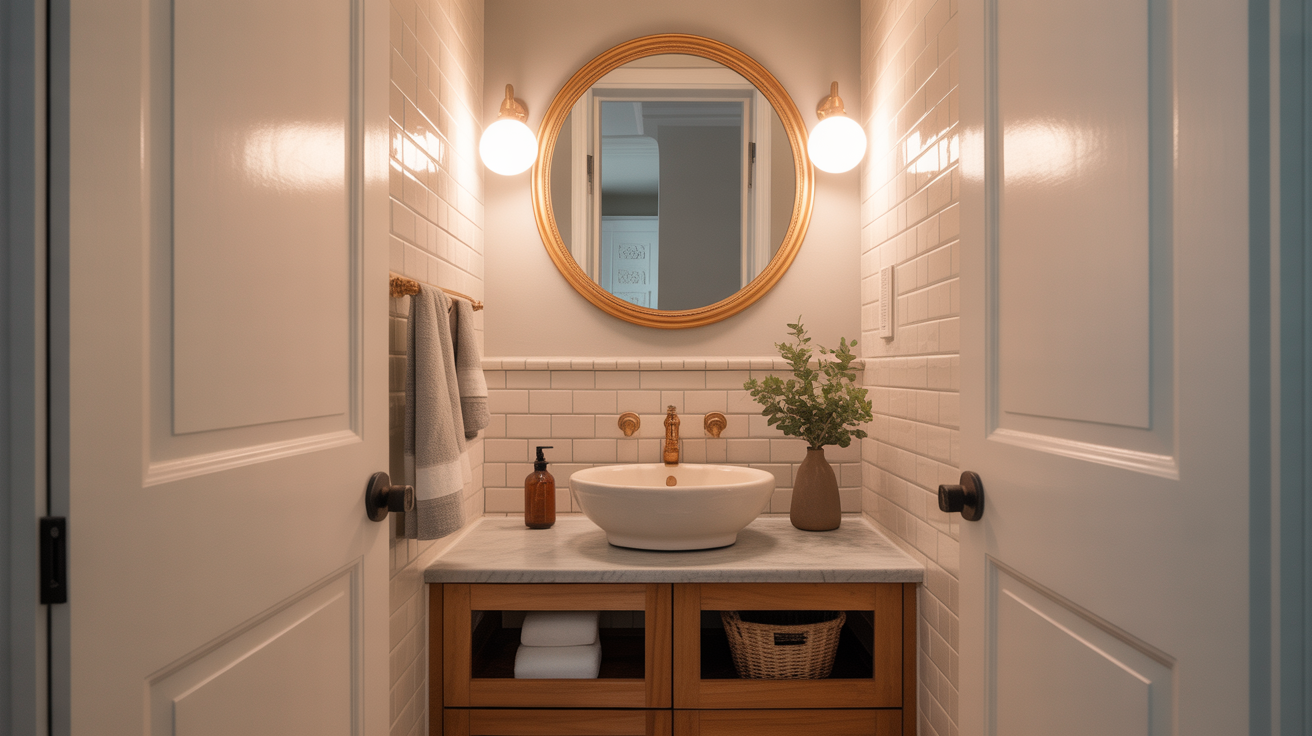
A half bath only needs a toilet and a sink, which means almost any odd corner of a house can become one. You do not need 36 square feet of perfect rectangle, you need to clear the right minimums and make smart choices about what goes inside.
At a Glance
- Code floor is 30 x 60 inches for a toilet-and-lavatory bathroom; treat that as the absolute minimum, not a target.
- Under-stairs baths work when you orient the toilet toward the tall end of the triangle and vent mechanically, most have no exterior wall.
- A compact elongated or round-front toilet recovers 2-4 inches of depth; a wall-hung toilet recovers 4-6 inches for $400-$900 more in parts.
- Pocket or barn doors are close to mandatory in anything narrower than 40 inches; a hinged door eats the clearance you just fought to gain.
- Windowless half baths need a minimum 50 CFM exhaust fan; a recirculating carbon-filter unit is a fallback, not a first choice, in most codes.
- Large-format floor tile and one continuous wall material make a 15-square-foot room read as designed rather than squeezed in.
What "Tiny" Actually Means: Minimum Dimensions
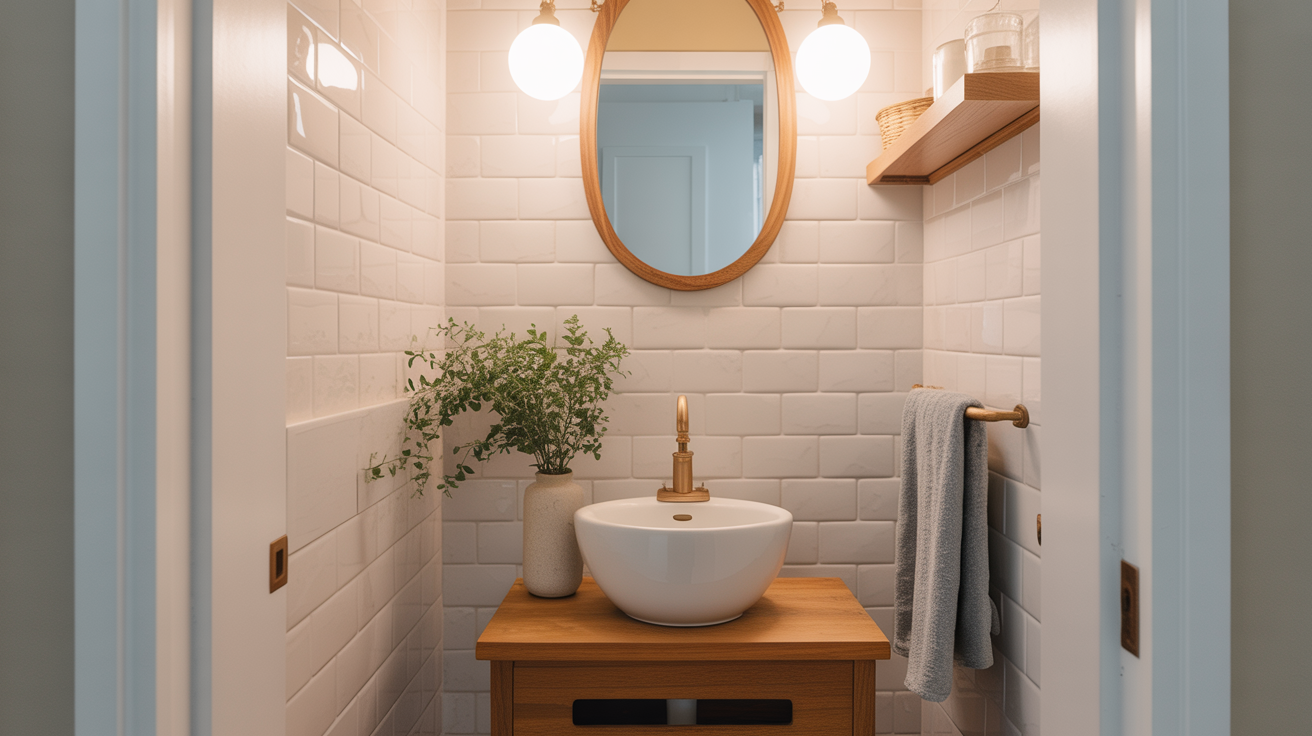
The International Residential Code sets a floor of 30 inches wide by 60 inches long for a bathroom containing only a toilet and a lavatory. Many jurisdictions adopt those numbers directly, but some go lower or have specific fixture-clearance rules that override them. Before you frame a single wall, pull your local code, and get a licensed plumber involved before any drain or supply work.
Working numbers that satisfy IRC and most local adoptions:
- Toilet rough-in: 15 inches minimum from the center of the drain to any side wall or obstruction (18 inches feels comfortable; 15 is the code floor).
- Clearance in front of the toilet: 21 inches minimum from the front of the bowl to the opposite wall or door swing (some codes say 24 inches, which is far more usable).
- Lavatory clearance: 21 inches in front; at least 4 inches from the basin center to any side wall, 15 inches between lavatory centers if two are present (uncommon in a half bath).
- Ceiling height: 80 inches over the required floor area, though a sloped ceiling can dip lower outside that zone, useful under stairs.
If your available footprint is smaller than 30 x 60 inches, stop before framing. No amount of clever fixtures will fix a room that does not meet code.
It's worth knowing that these IRC numbers are the residential minimums, not the only clearance standard in circulation. The U.S. Access Board's accessibility guidelines call for a much larger 60-by-56-inch clear floor space around a toilet and a 30-by-48-inch clear approach to a lavatory, figures meant for wheelchair users rather than general residential use. You don't need to hit those numbers in a typical half bath, but if you're building a bathroom that might need to serve an aging family member down the road, framing a few extra inches now is far cheaper than a second remodel later.
Under-Stairs Half Baths: Working With the Slope
The triangular void beneath a staircase is one of the most common spaces people try to convert. It can work, but the geometry demands a specific layout.
Orient the toilet toward the tall end
Position the toilet toward the deepest part of the triangle, where the full headroom is. You need at least 80 inches of clearance above the seat and the area immediately in front of it. The lavatory can go where the ceiling slopes down, since you can lean over a sink without standing upright.
Use a compact elongated or round-front toilet
Standard toilets project 28-30 inches from the wall. A compact elongated model runs 26-27 inches; a round-front bowl cuts that to 25-26 inches. In a space where every inch counts, that 2-4 inch difference can mean the difference between a 21-inch clearance and a code failure. Corner toilets mount diagonally and measure roughly 22 inches from corner to bowl tip, which helps in very tight triangles.
Plan ventilation early
Under-stairs baths frequently have no exterior wall. IRC requires mechanical ventilation when there is no operable window: a minimum 50 CFM exhaust fan on a timer or humidity sensor. Running duct through the stair structure is possible but needs to be coordinated before framing closes. A licensed HVAC or plumbing contractor can tell you the shortest legal path to exterior air.
A windowless triangle under a staircase is also the room most prone to trapped moisture, since there's no natural airflow to help the fan along. The EPA's guidance on moisture control points out that any warm, humid air that meets a cooler surface condenses, and a half bath tucked against an exterior-facing stair wall is exactly that kind of surface. Insulate the duct run if it passes through an unconditioned space, or you'll get condensation dripping back into the fan housing instead of exhausting outside.
Narrow and Closet-Conversion Half Baths
Converted hall closets and narrow side rooms, the kind that are 36-42 inches wide but 5-6 feet deep, present a different challenge. Width is fixed; you are working with a hallway shape.
Pocket doors are often the only option
A standard hinged door swinging into a 36-inch-wide space immediately eats the clearance you need in front of the toilet. A pocket door slides into the wall and keeps the full floor area usable. If a pocket door is not feasible (because of wiring or an existing drain), a barn-style door on a surface-mounted track works on the outside of the opening. Neither requires any floor clearance. Just note that barn doors do not seal as tightly, which matters more in a half bath near a dining room than in a utility area.
Stack fixtures on one wall
In a narrow room, placing the toilet and lavatory on the same wall with the door on the opposite short end keeps both clearance zones separate. You walk in, close the door behind you, and the entire 5-6 foot length is in front of both fixtures. This is cleaner than putting fixtures on opposite walls in a 36-inch-wide room, where the toilet's front clearance would collide with the lavatory's front clearance.
Pedestal sink vs. small vanity
A pedestal sink takes up almost no visual space and can fit in as little as 17 inches of wall width. The tradeoff is zero storage. A wall-hung vanity in the 18-24 inch range gives you a drawer or two and a countertop while keeping the floor open, which makes the room read as larger. For a half bath, that extra storage matters less than it would in a full bath, most guests only need a place to wash hands. See our guide to small bathroom storage ideas that save space if the lack of storage is a deal-breaker.
Fixture Choices That Recover Inches
| Fixture | Typical projection or width | Space recovered vs. standard | Rough cost premium |
|---|---|---|---|
| Round-front toilet | 25-26 in. | 3-4 in. vs. standard elongated | None; often cheaper |
| Compact elongated toilet | 26-27 in. | 2-3 in. | $0-$50 |
| Corner toilet | ~22 in. from corner | Diagonal fit in tight corners | $50-$150 |
| Wall-hung toilet | Projects per bowl; tank in wall | Gains 4-6 in. of floor depth | $400-$900 in parts |
| 18 in. wall-hung vanity | 18 in. wide, 14 in. deep | Replaces 24 in. standard | Comparable to a floor cabinet |
| Pedestal sink (small) | 17-20 in. wide | No cabinet bulk; floor stays open | Usually the cheapest option |
| Vessel sink on shelf | Varies | Eliminates below-counter cabinet depth | Depends on shelf/counter material |
Wall-hung toilets are worth considering in any tight half bath. Moving the tank into the wall recovers 4-6 inches of floor depth, and the exposed floor underneath makes cleaning easier. Installation costs more, the carrier frame and in-wall tank add $400-$900 in parts alone, not counting rough-in labor, but in a space where 5 inches is the difference between workable and not, the math often makes sense. A worked example: a room that measures exactly 30 inches deep from the wall to the door swing will fail the 21-inch clearance rule with a 30-inch-projection standard toilet (only 0 inches of margin once you subtract the 15-inch rough-in offset from the wall). Swap to a wall-hung unit that projects 19-20 inches from the finished wall, and the same room clears the 21-inch rule with room to spare.
Ventilation in a Windowless Half Bath
A half bath without mechanical ventilation will smell within weeks. Options:
- Inline exhaust fan: Quieter than a standard bath fan, mounted in the duct line above the ceiling rather than at the register. Panasonic and similar brands make models rated 50-110 CFM with built-in humidity sensors. Run it on a timer so guests cannot forget to turn it on.
- Recirculating fan with carbon filter: Mounts in the ceiling, draws air through an activated charcoal filter, and returns it to the room. No ductwork required. It handles odors well but does not remove moisture. Acceptable in a very dry climate for a half bath (no shower = minimal steam), but check your local code, some jurisdictions do not allow recirculating fans as a substitute for vented exhaust.
- Transfer grille: In some configurations, a grille connecting the half bath to an adjacent room that does have ventilation satisfies code. This is a contractor or building-department conversation, not a DIY call.
For sizing, a half bath under about 50 square feet is well served by a 50 CFM fan; if the duct run is long or has more than two elbows, bump up to 80-110 CFM to compensate for the added static pressure. A fan rated for the room but choked by 15 feet of crushed flex duct will underperform no matter what the box says.
For a deeper look at how layout decisions affect ventilation and storage together, the best layouts for a small bathroom covers those tradeoffs in a full-bath context that applies here too.
Design: Making a Tiny Powder Room Feel Considered
A half bath that fits 15 square feet can still feel intentional rather than crammed. A few approaches that work in small rooms:
Use large-format tile on the floor. Counterintuitively, a 12x24 or 18x18 tile has fewer grout lines and reads as less busy than small mosaic tile in a tight space. It also photographs well if you ever sell the home.
Carry one material from floor to wainscot or ceiling. Tiling three walls of a small half bath in the same material, or going floor-to-ceiling on one accent wall, makes the room feel like a decision rather than an afterthought.
Go dark. Small rooms often benefit from deeper colors rather than the instinct to go white. A charcoal, forest green, or navy creates a sense of depth that a white box in the same 20 square feet does not.
Light from above. A recessed fixture directly over the vanity throws the most useful light without competing for wall space. If you have a pocket door framed into the wall, a sconce is harder to place cleanly, a ceiling fixture solves the problem.
For more ideas on visual tricks that make small rooms read larger, small bathroom ideas to make it feel bigger covers mirrors, light, and tile in more depth.
Frequently Asked Questions
How small can a half bath legally be?
The IRC sets a minimum of 30 inches wide by 60 inches long for a toilet-and-lavatory bathroom. Local codes vary, some jurisdictions allow smaller footprints, others require more clearance. Always verify with your local building department before framing.
Do I need a permit to add a half bath?
Almost certainly yes if it involves new plumbing, which most half bath additions do. Permits protect you: an unpermitted bathroom can complicate a home sale and may not be covered by your homeowner's insurance if something fails. Budget for permit fees and inspections from the start.
Can I put a half bath under the stairs without a window?
Yes, as long as you provide mechanical ventilation. IRC requires a minimum 50 CFM exhaust fan when there is no operable window. You will need a path to exhaust air to the exterior, so plan the duct route before any framing goes up.
What is the smallest toilet available?
Several manufacturers make "compact" models with a bowl-to-wall depth of 25-27 inches versus the standard 28-30 inches. Galba, TOTO, and American Standard each have compact or round-front options in that range. Corner-mount toilets (which install diagonally in a corner) project even less from any single wall. Measure your specific clearance needs before buying, specs vary by model.
Is a wall-hung toilet worth the extra cost in a tiny half bath?
Often yes. Moving the tank into the wall recovers 4-6 inches of floor depth, which in a 30-inch-deep room can mean the difference between meeting the 21-inch front clearance and falling short. The installation is more involved and costs more upfront, but it is a legitimate code-compliant way to gain real space rather than a design trick.
What is the smallest legal ceiling height for a half bath under a staircase?
The IRC requires 80 inches of headroom over the required floor area of the fixtures themselves, but it allows the ceiling to slope lower outside that zone. In practice that means the toilet needs full headroom directly above and in front of it, while the lavatory, which you lean over rather than stand fully upright at, can sit under a lower slope. Measure headroom at the exact spot where each fixture will land before you commit to a layout.
Can I add a half bath without moving any existing plumbing?
Only if the new location is close to an existing drain and vent stack, generally within about 5-6 feet for a gravity-fed connection, or if you use a macerating (upflush) toilet system, which grinds waste and pumps it through smaller-diameter pipe over longer horizontal or even vertical runs. Macerating systems cost more per fixture but can make an otherwise plumbing-inaccessible closet or under-stairs space workable. A licensed plumber can tell you whether your specific drain layout supports a gravity connection or needs the upflush route.