Bathroom Design
Wet Room Design: Is an Open Shower Right for You
Explore wet room ideas, open shower bathroom layouts, and curbless shower options to decide if this design is right for your next renovation.
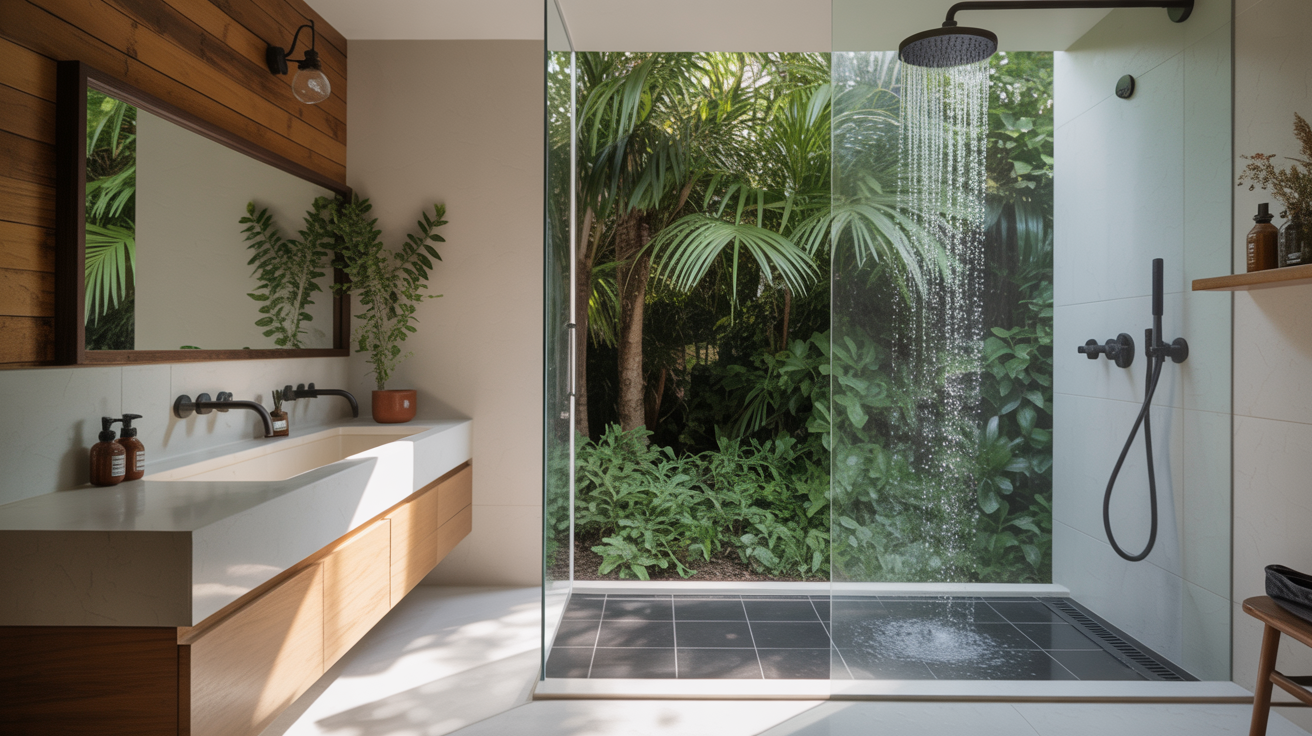
A wet room is a fully waterproofed bathroom where the shower has no enclosure, no curb, and no door separating it from the rest of the space. The floor drains the water, and the walls are sealed top to bottom. The result is an open, airy room that often feels larger than its square footage suggests.
The build requires careful planning. Waterproofing failures are the biggest risk, and retrofitting an older home's subfloor to handle a curbless drain can get complicated fast. This guide covers what wet rooms actually involve, where they work best, and what to think through before you commit.
At a Glance
- A true wet room waterproofs the entire bathroom floor; a curbless shower waterproofs only the shower footprint and costs less.
- The floor must slope at least 1/4 inch per foot toward the drain, the same tolerance used in accessible roll-in shower design.
- Wet rooms need more ventilation than an enclosed shower, aim for at least 1.5 CFM per square foot of floor area, vented to the exterior.
- A wood-framed floor typically needs subfloor work to handle a full wet room; a concrete slab is a much simpler starting point.
- Linear drains allow a single-slope floor; point drains need a four-way slope that's harder to execute with larger tile.
- A curbless conversion usually costs 20 to 40 percent more than a standard tub-to-shower swap because of the added waterproofing and slope work.
What Makes a Wet Room Different from a Walk-In Shower
People use "wet room," "open shower bathroom," and "curbless shower" interchangeably, but there are real distinctions worth understanding before you start planning.
| Type | Waterproofed Area | Relative Cost | Best Fit |
|---|---|---|---|
| True wet room | Entire bathroom floor, lower walls | Highest | Small bathrooms, European-style layouts, full renovations |
| Curbless shower | Shower footprint only | Moderate | Most North American remodels wanting the open look |
| Curbed walk-in shower | Shower pan only | Lowest | Standard remodels, tightest budgets |
The True Wet Room
A true wet room has no fixed shower zone. The entire bathroom floor is waterproofed and slopes gently toward one or more drains. You can place the showerhead anywhere on the wall, and water runs off wherever it lands. The toilet, sink, and shower coexist in one open waterproofed shell.
This layout is common in European bathrooms and in smaller spaces where carving out a separate shower enclosure would leave the remaining floor area feeling cramped.
The Curbless Shower
A curbless shower is more common in North American remodels. The shower area is still defined, but there is no threshold or raised curb at the entry. The floor transitions seamlessly from dry zone to wet zone, usually with a linear drain along one wall or a point drain recessed into the floor.
Most of what gets called a wet room in home design content is really a curbless shower with a glass panel or open entry. Both are valid; the distinction is how much of the bathroom floor is actively waterproofed and drained.
Why the Difference Matters for Your Budget
A full wet room waterproofs the entire floor and often the lower portion of all walls, which costs more in materials and labor than a curbless shower that waterproofs only the shower footprint. On a wood-framed floor with a crawl space or basement below, a full wet room also means more structural work to handle water weight and vapor. If budget is tight, a curbless shower gives you most of the visual and accessibility benefits for less construction cost.
Who Benefits Most from Wet Room Ideas
Not every bathroom is a good candidate. A few situations where wet rooms genuinely work well:
Accessibility and Aging in Place
A curbless entry removes the single biggest trip hazard in a conventional shower. Wheelchair access becomes possible, and people with limited mobility can enter without stepping over anything. The U.S. Access Board's accessible design guidance for bathing rooms specifies a roll-in shower compartment at least 30 inches deep and 60 inches wide, a threshold no higher than 1/2 inch, and a floor slope no steeper than 1:48 toward the drain, the same 1/4-inch-per-foot figure most wet room contractors already build to. Plan the showerhead location and any grab bar blocking at the same time as the layout. Retrofitting blocking into a fully tiled wall later is a much bigger job than adding it during the original build.
Small Bathroom Layouts
Removing a shower door or enclosure frees up a surprising amount of visual and physical space. A wet room or curbless shower in a 5 by 8 foot bathroom can feel noticeably less cramped than the same room with a framed corner unit. The floor reads as continuous, which makes the room look longer. See how a curbless shower fits into different room shapes in our guide to bathroom layout ideas that make the most of your space.
Master Suite Renovations
Wet rooms are closely associated with high-end renovation. Large-format stone tile, a linear drain, and a rain head overhead create a cohesive, minimal look. If the aesthetic matters as much as the function, a well-executed wet room can deliver both. See how this fits into specific styles in our guide to modern farmhouse bathroom ideas that still feel fresh.
The Build Requirements You Need to Understand
This is the part most design-focused articles skip over, and it is the part most likely to affect your budget and timeline.
Floor Slope and Drainage
The floor must slope toward the drain at a minimum of 1/4 inch per foot. In a full wet room, that slope covers the whole bathroom floor. Achieving a consistent slope during tile installation requires either a mud bed or a prefabricated shower pan, and the drain position has to be planned before any tile goes down.
Linear drains run along one wall and allow the floor to slope in a single direction, which is simpler to tile. Point drains in the center require the floor to slope from all four sides simultaneously, which is harder to execute cleanly with larger format tile. Both work well; the choice affects your layout options and your tiling costs.
Waterproofing Systems
Cement board alone is not waterproofing. A wet room needs a membrane (either sheet-applied or liquid-applied) behind the tile on walls and under the tile on floors. The membrane extends past the shower area in a full wet room. Joints, corners, and transitions all get fabric tape embedded in the membrane before tile goes down.
Skipping or underbuilding the waterproofing leads to water infiltrating the subfloor, rot, and mold behind the tile. That is a strong argument for hiring a tile contractor who specializes in wet work rather than a general handyman.
Ventilation
An open shower bathroom puts more moisture into the air than an enclosed shower does. For a wet room, aim for at least 1.5 CFM per square foot of bathroom floor area, higher than the standard minimum. Verify the fan vents to the exterior, not into the attic or crawl space. Recirculating fans handle odors but do nothing for humidity.
The stakes are real: the EPA's guide to mold and moisture control recommends keeping indoor relative humidity below 60 percent, ideally between 30 and 50 percent, and points to ventilation as the primary lever for getting there. In a room designed to keep water on the floor rather than behind a door, an undersized fan is the difference between a bathroom that dries out in twenty minutes and one that stays damp long enough for mold to establish on grout and drywall elsewhere in the room.
Glass Panels and Splash Control
Most open shower bathrooms use at least one fixed glass panel to contain splash. A panel placed perpendicular to the showerhead, or angled to shield the vanity, stops most water drift without closing off the space. Frameless panels with minimal hardware maintain the open feel better than framed enclosures.
If privacy matters, a partial knee wall or half wall in tile can screen the shower area without adding a door.
Wet Room Design: Tile, Drain, and Finish Choices
The materials you choose shape both the look and the long-term maintenance.
Tile Size and Slip Resistance
Larger tile means fewer grout lines, but the slope execution gets harder with 24 by 24 inch or larger tiles. Many designers use smaller mosaic tile on wet room floors, where more grout lines help with drainage and texture improves traction. Floor tile in wet areas should have a Coefficient of Friction (COF) of at least 0.6 wet. Matte finishes hold grip better than polished stone or glossy ceramic. To get the polished-stone look, limit it to the walls and use a textured tile on the floor.
Linear vs. Point Drains
Linear drains allow a single-slope floor and can be positioned along any wall. They clean easily and collect hair without the small grate of a point drain. Point drains work well in smaller shower footprints and are generally less expensive, though tiling labor may offset that. Match the drain finish to your fixtures: brushed nickel, matte black, and unlacquered brass hold up better in humid environments than standard chrome.
Color and Material Consistency
Treating the shower zone and the rest of the bathroom as one continuous surface reads as intentional. Using the same tile on floors and walls, or the same grout color throughout, makes the wet room feel designed rather than improvised. A contrasting niche or accent band adds variation without breaking the visual flow. Our guide on how to choose a bathroom color scheme you won't tire of walks through how to pick tones that hold up across years of daily use.
Frequently Asked Questions
Do wet rooms always require a full bathroom renovation?
Not necessarily. If your existing bathroom has a concrete slab floor, converting an existing shower to curbless is more straightforward. A plumber and tile setter can assess whether the current drain location works or whether rough plumbing needs to move. On wood-framed floors, expect to open the subfloor to install proper support and waterproofing, which is closer to a full renovation even if the rest of the room stays intact.
How much does a wet room cost compared to a standard shower?
Cost depends on your subfloor type, the size of the waterproofed area, the tile, and local labor rates. A curbless shower conversion typically runs 20 to 40 percent more than a standard tub-to-shower conversion because of the additional waterproofing and slope work. A full wet room costs more still. Get quotes from at least two contractors who can assess your specific subfloor before budgeting.
Will a wet room make my bathroom floor harder to keep dry?
Yes, the floor will get damp during and after showering. Water travels further without a curb or door to contain it. Good ventilation dries things faster, and a partial glass panel can limit how far water reaches. People who want a fully dry zone outside the shower are usually better served by a defined curbless shower area with a fixed panel rather than a fully open wet room.
Can I add a wet room to an older home?
Yes, but expect more prep work. Older homes often have unlevel subfloors and outdated plumbing that need addressing before waterproofing goes down. Have a contractor assess the subfloor if the home is more than 40 years old. The build is doable; it just takes more planning than new construction.
Is a wet room harder to clean than a tiled shower enclosure?
The cleaning routine is different, not harder. There is no glass door track to scrub, but you need to dry down a larger tile area or let ventilation pull moisture out quickly. Sealed grout and a consistent tile surface throughout the room can simplify maintenance compared to mixed surfaces in an enclosed shower.
What size exhaust fan does a wet room actually need?
Size it to the room, not to a generic bathroom rule of thumb. Multiply the bathroom's square footage by at least 1.5 CFM to account for the larger exposed wet area, then round up to the next standard fan size rather than down. A 50 sq ft wet room bathroom calls for at least a 75 CFM fan, and most installers will push that higher if the room has a tub as well as an open shower.
Can I put a wet room over a wood-framed second-floor bathroom?
Yes, but it needs engineering attention that a slab-on-grade wet room doesn't. The subfloor needs to be rigid enough to avoid flexing the waterproof membrane, and the assembly needs to manage vapor so moisture doesn't collect in the joist bay below. A structural engineer or an experienced remodeling contractor should confirm the floor system before you commit to a full wet room on an upper level, since a failure there is far more disruptive than one on a slab.